

Enjoy the Most Beautiful Ironworks Village in Finland in Peace – Fiskars, Founded in the 1600s, is a Stunning Autumn Destination in Raseborg
The parking area at Fiskars Ironworks is completely empty. I smile with delight as I see the text on the local bus passing by in the village: Ha en bra dag, ‘Have a good day’. Oh, yes. The ironworks, adorned in autumn colors and tranquility, feels in early October as if it exists just for me. My plan is to walk its two easy circular trails – the Upper Works culture path and the Tree species path, each a couple of kilometers (1,24 mi) long – and enjoy the autumn peace and postcard-like beauty of the ironworks village in between.
This year, Fiskars Ironworks in Raseborg, Southwest Finland, is celebrating its 375th anniversary. Founded in 1649, it is one of the most beautiful destinations in Finland. While Finland boasts many beautiful ironworks villages, Fiskars stands in a league of its own in terms of both its size and beauty. And yes, you are absolutely right: the orange, world-renowned Fiskars scissors originate from right here.
It’s no wonder that Fiskars is a popular summer destination, but it’s also a shame how many people think of it as just that – a summer destination. As the trees don their autumn coats, the streets of Fiskars start to empty of visitors. The clear water of the Fiskars River flows even more brightly, ducks preen their plumage, and the riverside path is deserted.
If you promise to keep a secret, I’ll reveal that autumn is an absolutely wonderful time to experience Fiskars. And although this article focuses on the fall, I must also whisper that I love this place in winter and spring as well. I adore silence and my own peace above all else. I enjoy visiting here specifically outside of the high season. For example, last spring my husband and I spent a night at the oldest inn in Finland, Fiskars Wärdshus, which has been in operation for nearly 200 years.
In addition to the wide and versatile range of handicrafts, Fiskars hosts year-round events, and the village offers plenty for those who enjoy nature. At the end of this article, you’ll find my tips on how to get to Fiskars by car, bus, or a train + bike combination.
So, let’s get going!
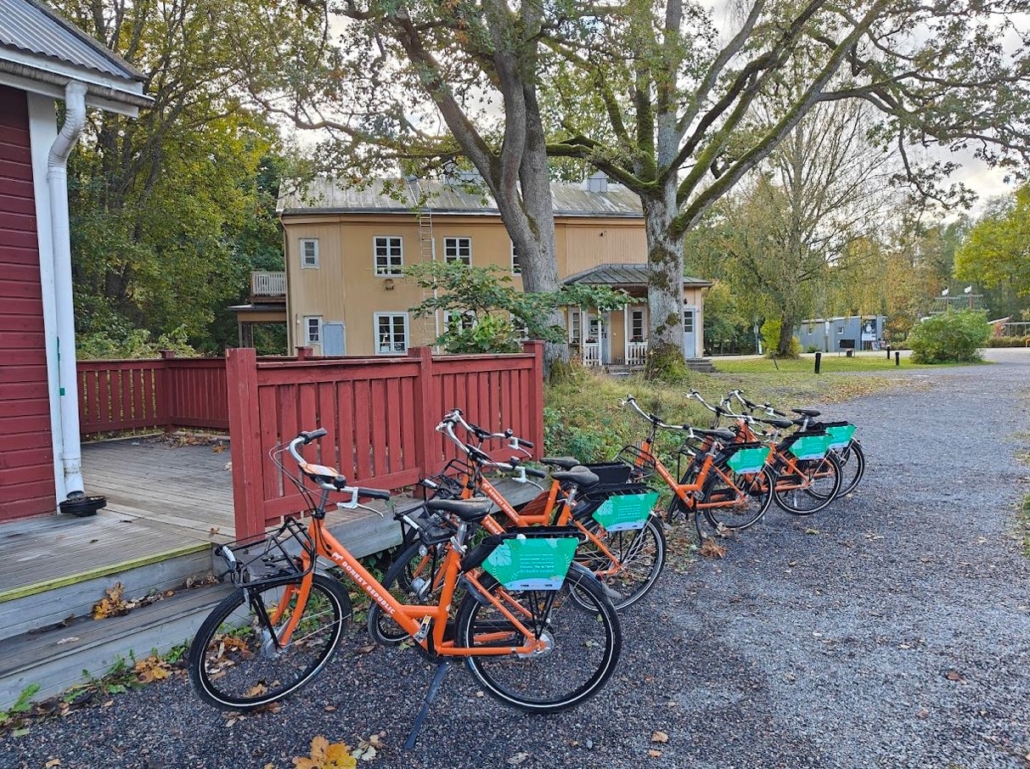
Right at the parking area, two things catch my attention: there’s a long row of city bikes available, and a large map at the edge of the parking lot gives hints about where to go, whether you choose to walk or cycle. I recommend taking a moment to study the map, as without it, you might miss out on a lot. The map makes it easy to grasp the village’s layout, and it also marks the circular trails: the Upper Works culture path (‘Yläruukin kulttuuripolku‘) with a gray dashed line and the Tree species path (‘Puulajipolku‘) with a white line. You can download the map in PDF format from the Fiskars website, and you’ll also find these same maps scattered throughout the village, which is very helpful.
Note! The Upper Works culture path and the Tree species path are not marked in the terrain. This is precisely why this map is so practical. If you don’t want to download the PDF file, take a picture of the map with your phone when you arrive so you’ll have it as your guide on the trails. I’ve marked my own starting points for the routes in this article with a map link, but of course, you can hop onto the trails at any point along their paths.
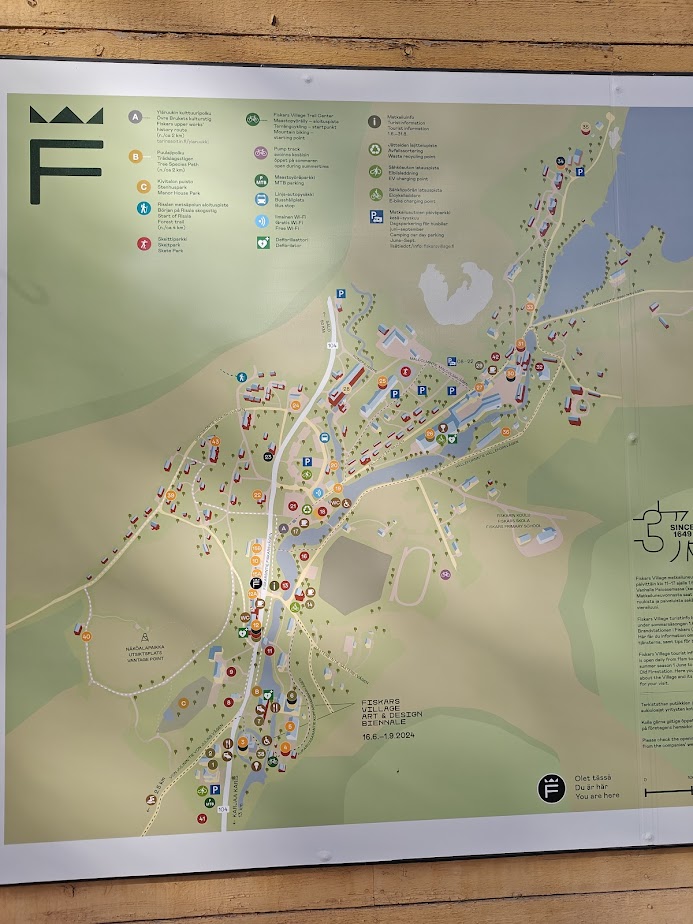
Upper Works Culture Path
- Starting point on the map (Address: Peltorivi 1, Raseborg/Raasepori)
- Circular route 2 km/1,24 mi
There is also a separate map available for the Upper Works culture path, which you can follow while walking. The media guide can be accessed on the path’s own page and it can be set to English. The guide shows your location and the buildings along the path, each of which offers additional information when you tap on a marker. I opted for a combination approach: I read the texts in the media guide beforehand and memorized the route from the map above. This way, I didn’t need to keep looking at my phone while walking.
I cross the bridge over the gently flowing Fiskars River, which runs from Lake Degersjön through the ironworks village. A woman is walking her dog a little way off, and otherwise, the scenery is empty of people. I stop on the bridge to admire the water and the drifting autumn leaves, some of which have already settled on the shallow riverbed.
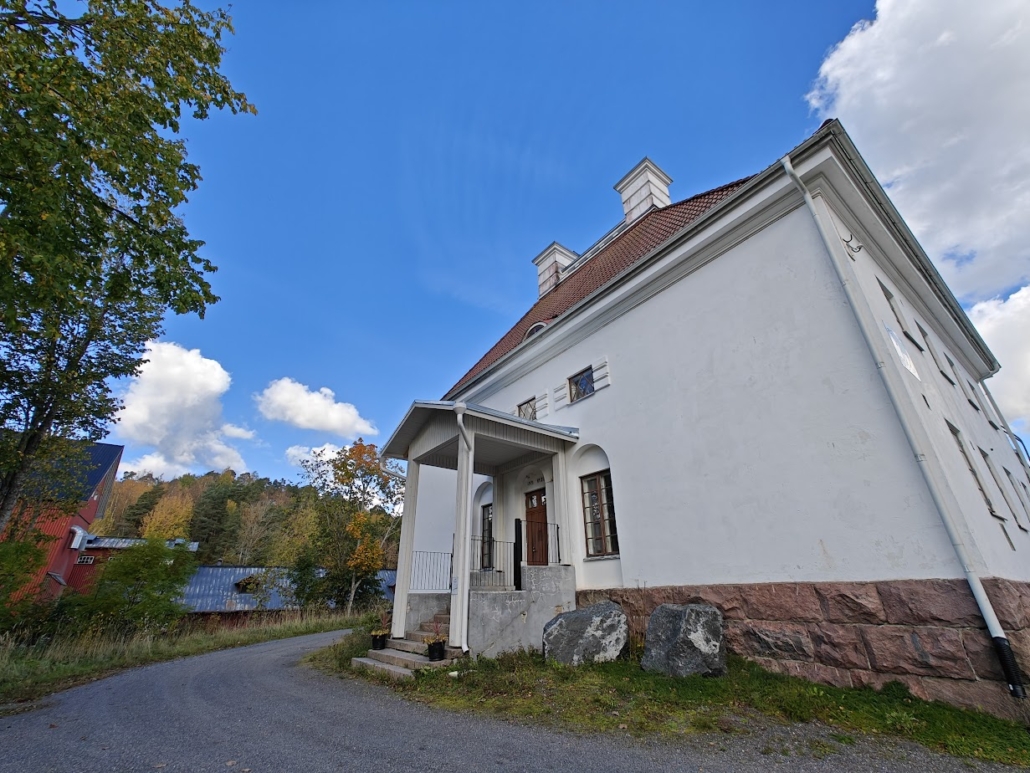
The large white stone building is one of the first sights when traveling clockwise. It is located along Isidorintie, a road named after an award-winning bull, Isidor, according to the media guide. The building itself is an old barn, but today it houses, among other things, a garden shop and a candle store.
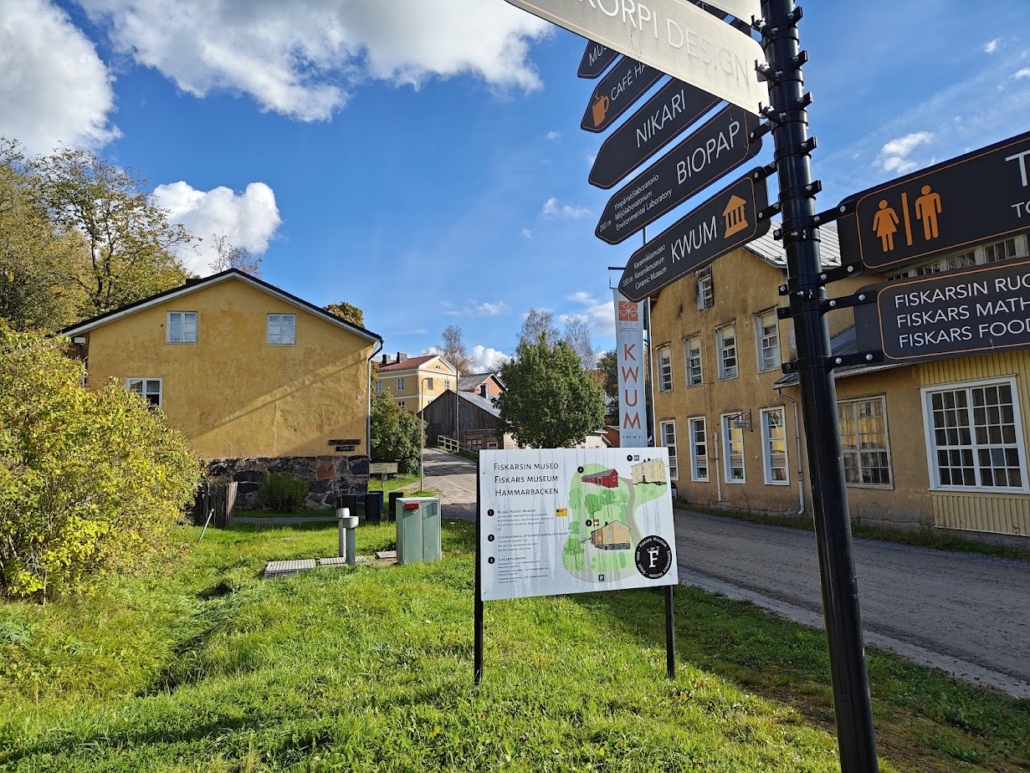
I walk past the corner of the barn, following the road curving toward the museum, passing by the skate park. A signpost brimming with directional signs reveals that Fiskars Ironworks’ glory days are far from over – museums, cafés, and various design spots can be found in all directions.
The long building on the right in the photo below below is the old plow workshop, completed in 1914, where up to 13,000 plows were manufactured annually in its heyday. An important piece of the country’s agricultural history! Nowadays, the building houses an artisan food shop, a bike repair shop, a veterinary clinic, and a carpenter’s workshop. I’m delighted to see that this old building still serves as a place of active craftsmanship. Fiskars has skillfully avoided the all-too-common fate where beautiful old buildings are left to deteriorate while new, unattractive structures are built for businesses and homes.
Opposite the plow workshop, the smaller yellow building is the office of the Fiskars Museum, formerly a canteen for workers. I walk uphill between the buildings, enjoying the wonderful October weather created by the autumn sun and wind, the fluffy clouds in the sky, and the silence. In the middle of the photo below, the yellow and red-roofed Fiskars Museum peeks out – a very beautiful building. The museum was established in 1949, but the building itself is an old office from the mid-1800s.
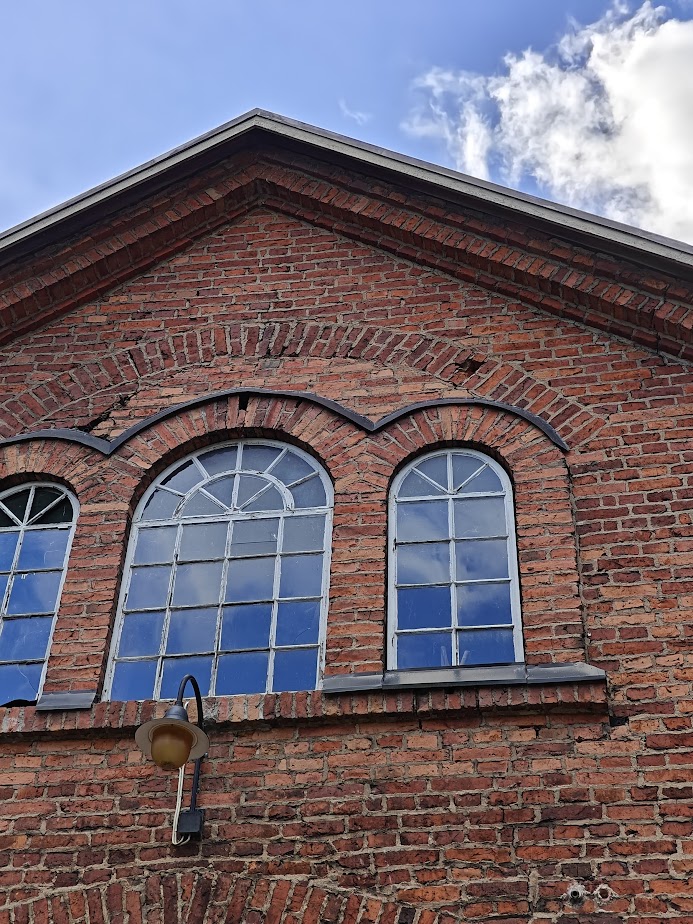
The decorative details of the red-brick machine shop stop me in my tracks. I admire the beautiful, curved shapes of the brick walls and windows. The building originally produced large iron objects for blast furnaces, steam engines, sawmills and paper mills. It was the first machine shop in all of Finland, established in 1837. According to the media guide, the first significant customer of the machine shop was the Finlayson cotton factory from Tampere, and the guide also features a black-and-white photo of the shop with its workers. Even today, this building is far from idle, now being the site where solid wood design furniture is crafted.
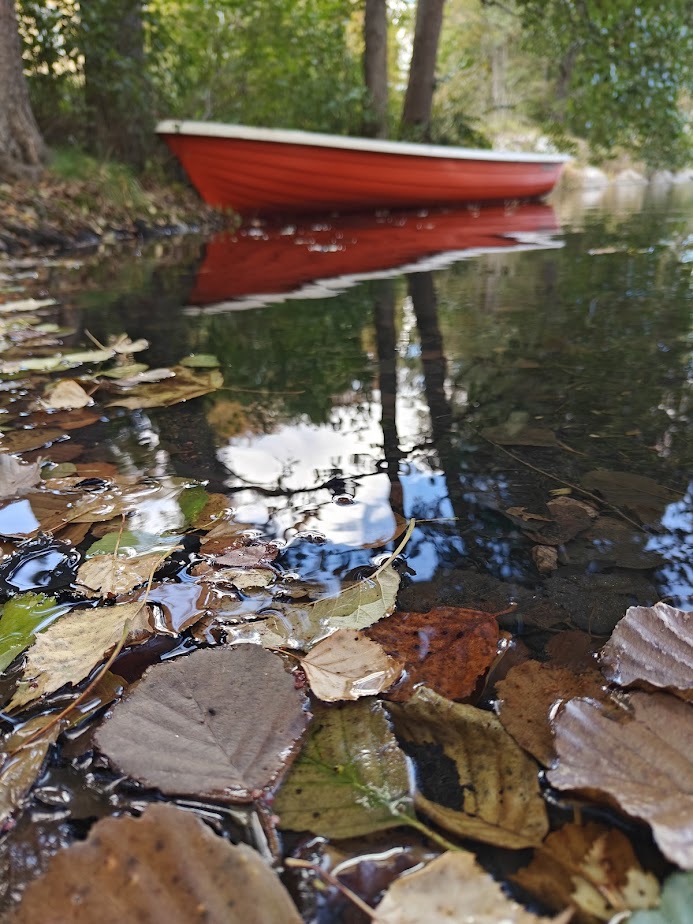
I’m delighted to find that there is access to the lakeshore. The gentle waves of Lake Degersjön lap against the shore, dancing hypnotically with the maple, birch, and alder leaves that have fallen into the water. The clear water is so beautiful that I find myself crouching down to touch it and even record a short video to capture a glimpse of its beauty. I stand at the spot where the Fiskars River begins. I might also be standing at the very origin of the village’s name, as legend has it that the village was named after a fisherman (fiskaren in Swedish) who settled on the shores of Lake Degersjön.
The media guide mentions that the ironworks’ employees had a unique employment benefit related to the lake, which today sounds almost utopian:
“Fiskars company allowed their workers to build small cottages for recreation on islands in the surrounding lakes. The first cottages were build already in 1880s which is rather unusual, since normally a worker would not afford a cottage.”
The land for the cottage was free, and the construction costs were covered by the workers themselves.
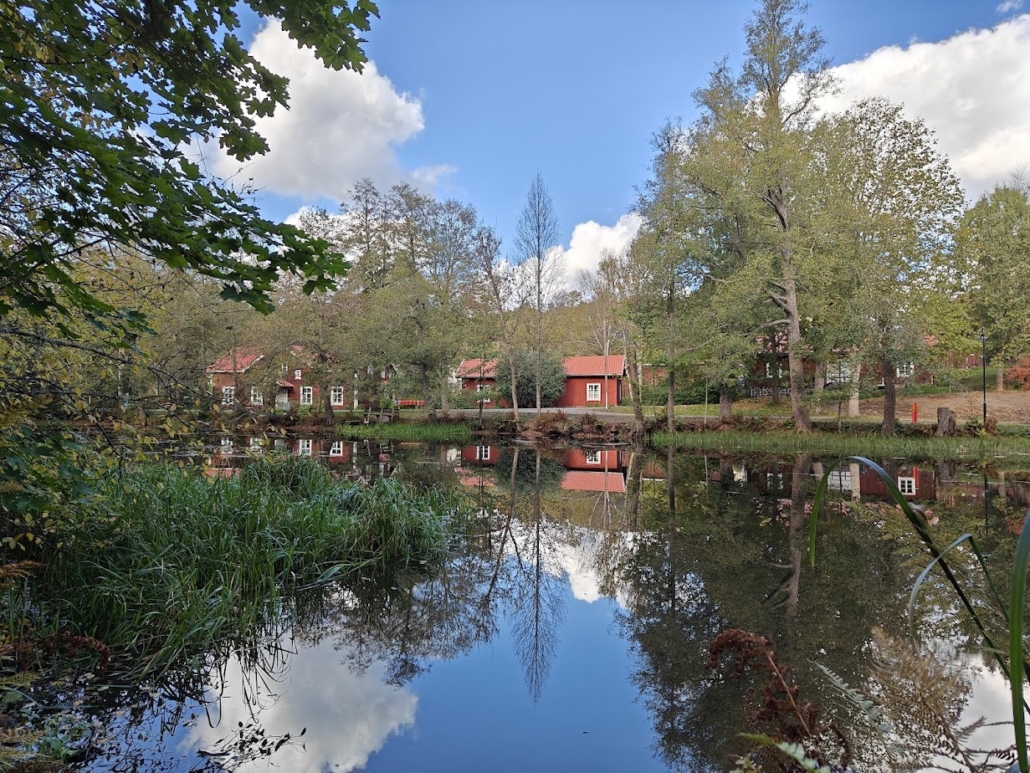
My journey continues along the banks of the Fiskars River. I pass by the charming old red building that stands atop the nearby Tabor Hill, heading back toward the center of the ironworks, now on the opposite side of the river. Tabor Hill is one of the oldest inhabited areas of the ironworks, with people living here since the 1700s. Although the current buildings seem to date from as early as the 1800s, they appear to still be in residential use, so I neither peek nor photograph the yards any further.
I pass the foundry on the slope, which dates back to 1836, and as I descend back to the river level, I see more red buildings on the opposite side of the water. Together with the river’s mirror-like surface, they paint a beautiful scene untouched by the teeth of our modern times.
The sun shines sharply through the yellow foliage, and the autumn atmosphere is palpable. The yellow wooden house up the slope adds its own touch to the color palette, as if it’s a part of the fall itself. This is the residence of the ironworks’ master builder from the turn of the 19th and 20th centuries, and it is still in residential use today.
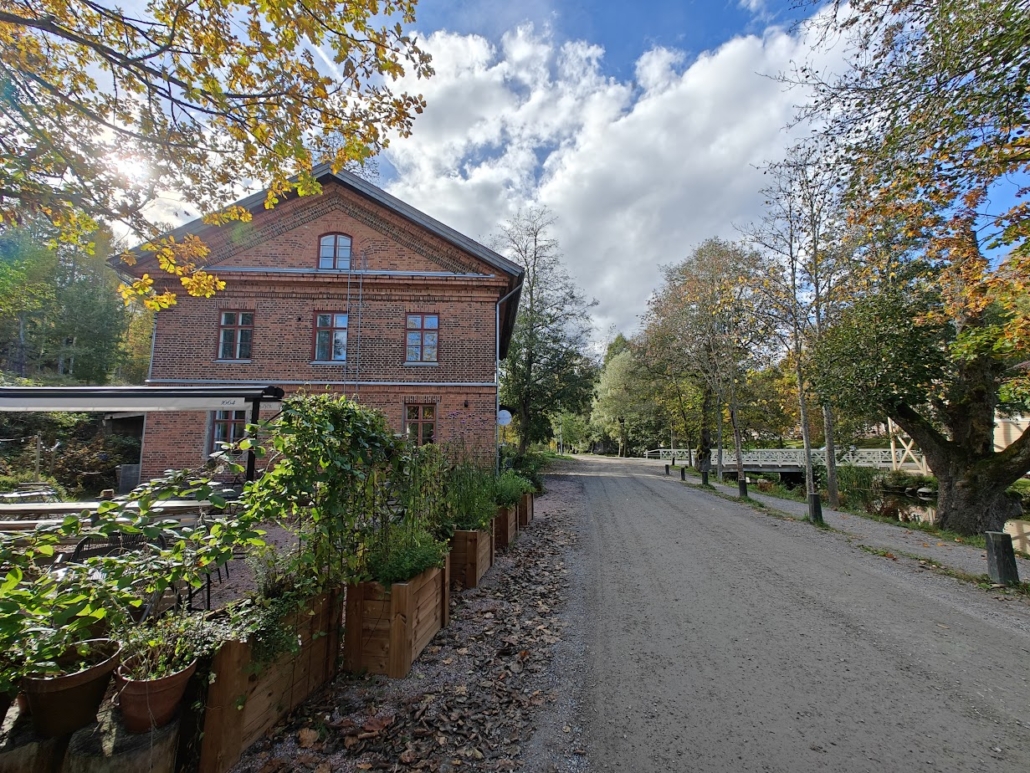
I’m beginning to arrive at the center of the ironworks. Once again, a picturesque red-brick building comes into view, and I remember sitting on this café’s terrace last May, enjoying a soda with my friend, who had come all the way from northern Lapland to experience the spring of southern Finland. We had just completed the Rissla Nature Trail (4 km/2,5 mi) here in Fiskars, and the moment of sipping soda on the sunny terrace, surrounded by the tranquility of Fiskars in May, felt perfect.
I notice that the café is currently closed, but fortunately, there are still other open spots to enjoy a treat.
The Beautiful Heart of Fiskars
The center of Fiskars is a patchwork of old, ornate, well-maintained buildings and the beautiful, clear, swiftly flowing waters of the Fiskars River. Its park-like surroundings invite you to pause at almost every step.
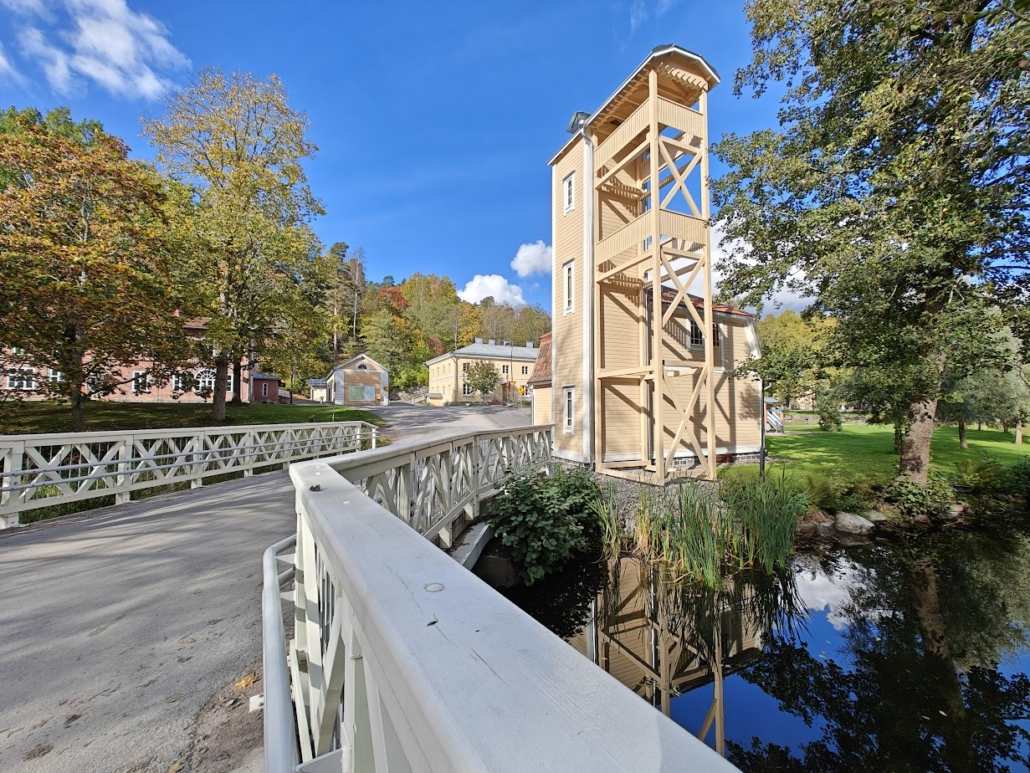
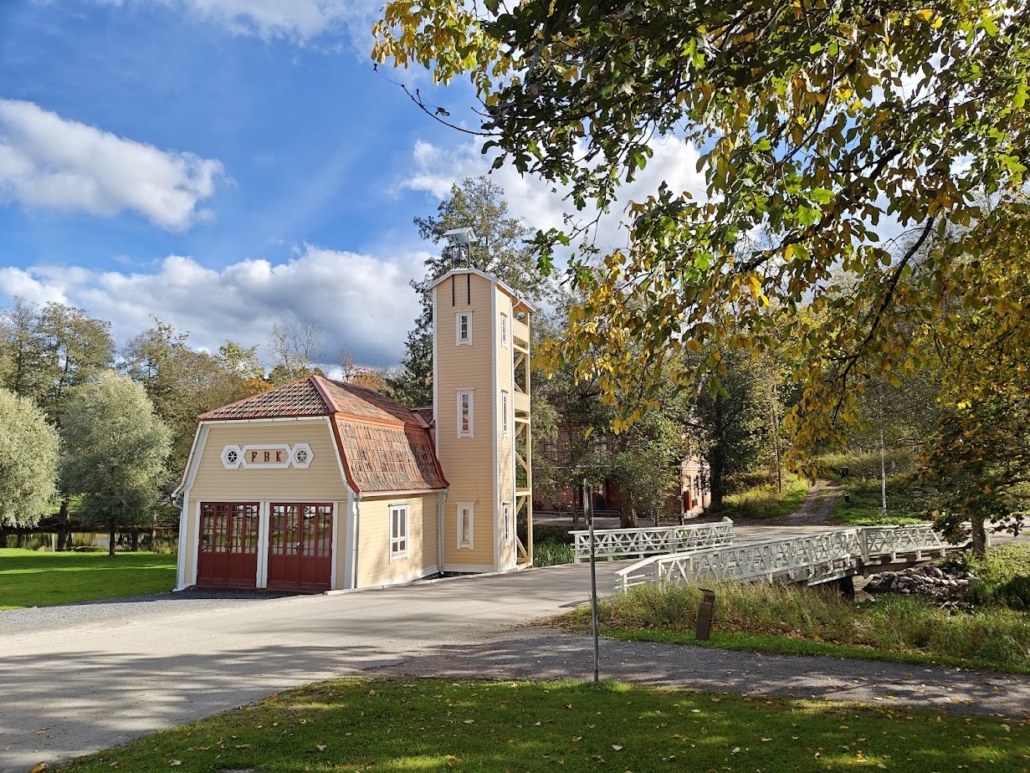
I recall the tall, wooden VFD building being under renovation some time ago, and now it gleams like new, despite being over a hundred years old. I cross the bridge next to it, heading to the main street of the ironworks, just to check the opening hours of Café Antique. I want to ensure that this visit to the ironworks does not end without a little treat. After all, what is a visit to an ironworks village without a coffee break! The café is open well into the afternoon, so I decide to first explore the center and the Tree species path, and then stop for coffee to conclude the experience.
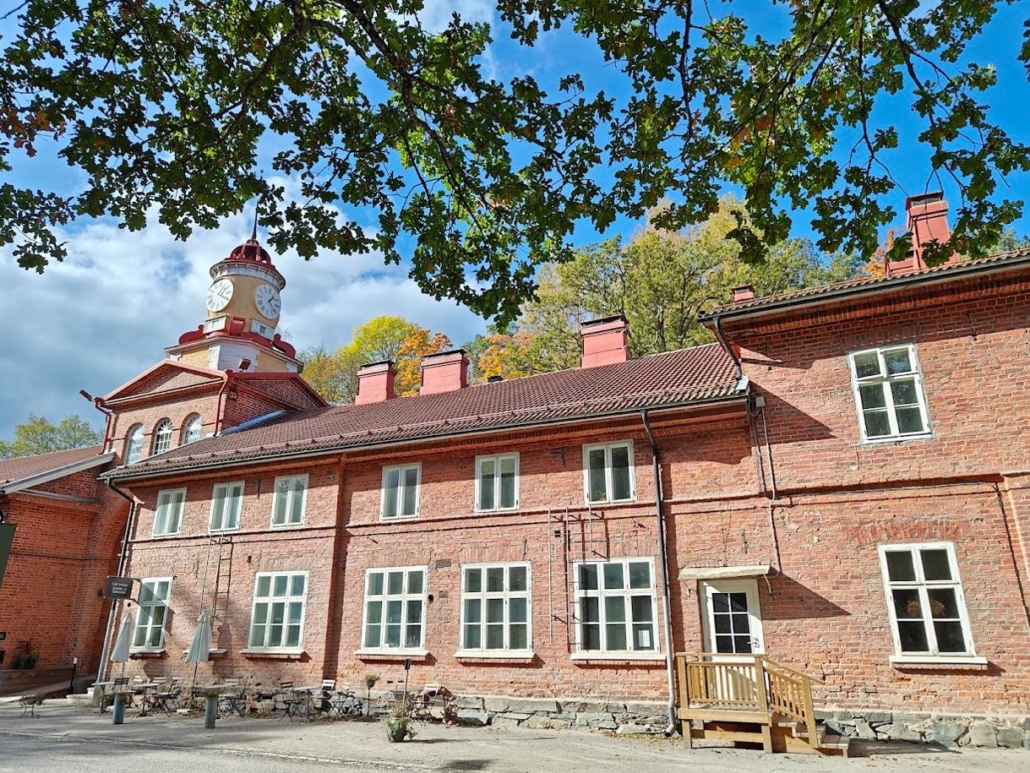
The building below is one of the most central and certainly one of the most photographed in Fiskars. Doesn’t it look incredible that the streets of a place so popular in summer are now completely empty? A true introvert’s dream!
Behind the clock tower, the autumn-colored maple foliage reaches high towards the blue sky. The Könni clock shows the time; it’s early afternoon. The building was completed as a school in 1826, but the clock tower was added slightly later. The Könni clock has been keeping time on Fiskarsintie road since 1842. The Könnis are a renowned Finnish clockmaking family, especially known for their grandfather clocks. So well-known, in fact, that some people in Finland might refer to grandfather clocks in general as “Könnis,” even if they were made by someone else. The Fiskars Könni is Könni number 9.
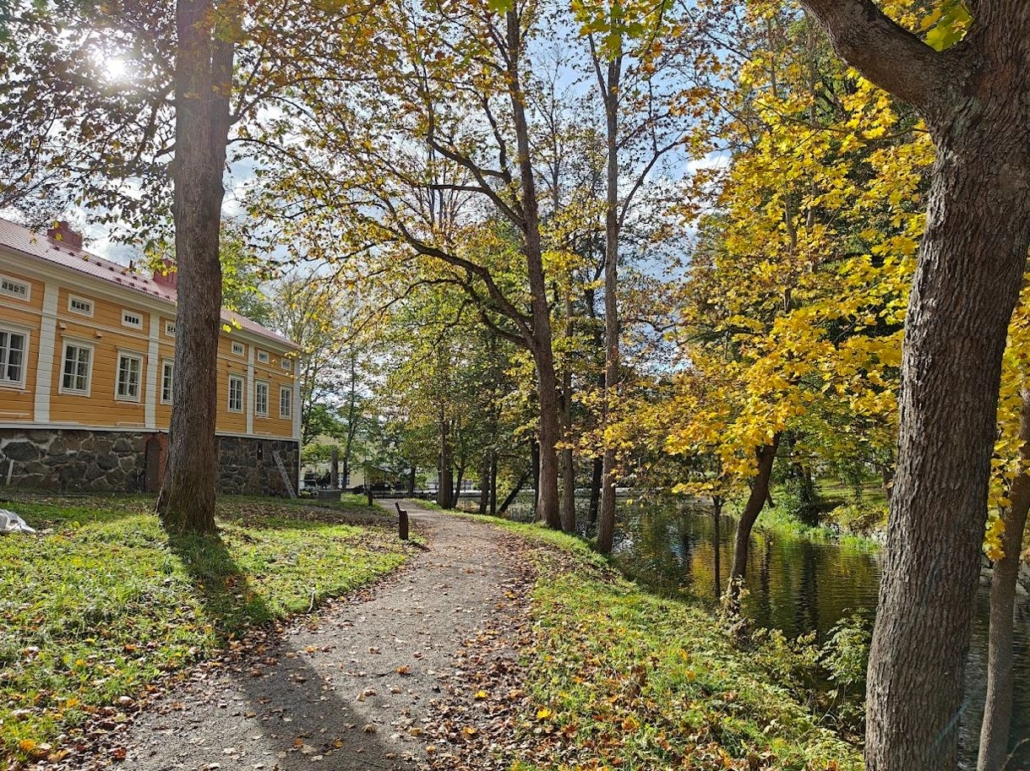
I cross back to the opposite bank of the river and slowly make my way towards the Tree species path. The day, the weather, and the surroundings are perfect for leisurely strolling and listening to my own whims, without any sense of rush or pressure. You can wander wherever you want, stop a hundred times if you like, visit shops or have a meal, or not. Despite the tranquility, many doors are visibly open. However, if you come here outside the peak season and intend to visit a specific shop or museum, be sure to check their opening hours carefully in advance.
The sound of the rapids fills the soundscape, and on the riverbank, an old slag-brick mill is currently being restored. It is one of the village’s most centrally located and, in my opinion, also one of the most beautiful buildings, so it feels good that it’s being cared for, even though it’s currently wrapped up and hidden from view. Another stunning slag-brick building can be found a short distance downstream; I will visit it shortly.
I pass a yellow and white wooden house that rises on a sturdy gray stone foundation, admiring its beauty, although its history remains a mystery to me.
A few steps away, the river widens and calms. Ducks preen themselves on the shore, as if time has stopped, and a lone female goldeneye dives on the water’s surface. I find my way to the riverbank once again to admire the clear water and the view that forms from the yellow maples, the still water, the blue sky, and the ironworks buildings. I circle the scenery clockwise, passing by the gallery, the restaurant Kuparipaja, and the stream beside it, which rushes beautifully and can be admired directly from the bridge above.
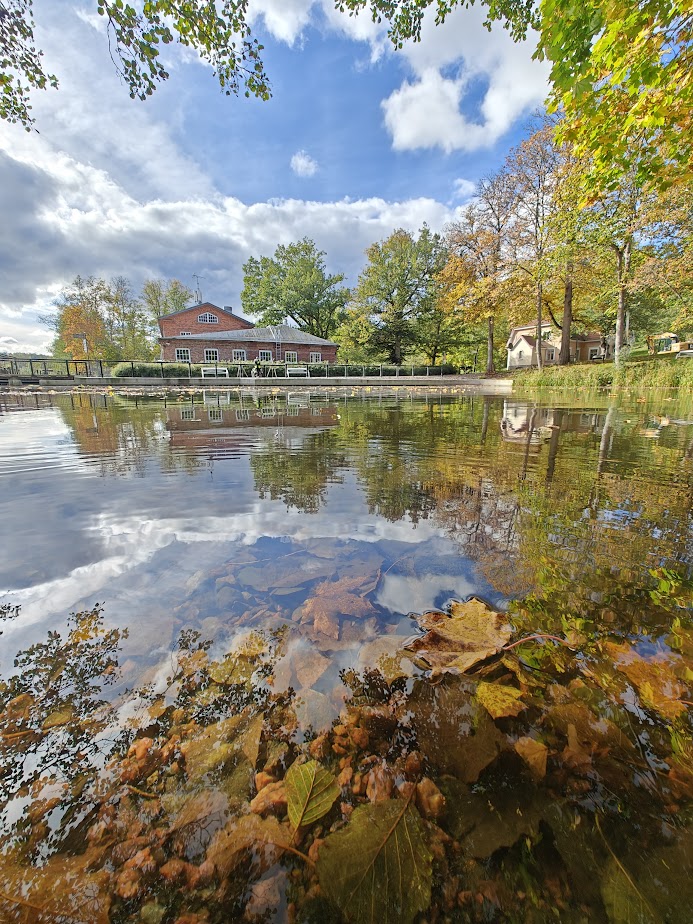
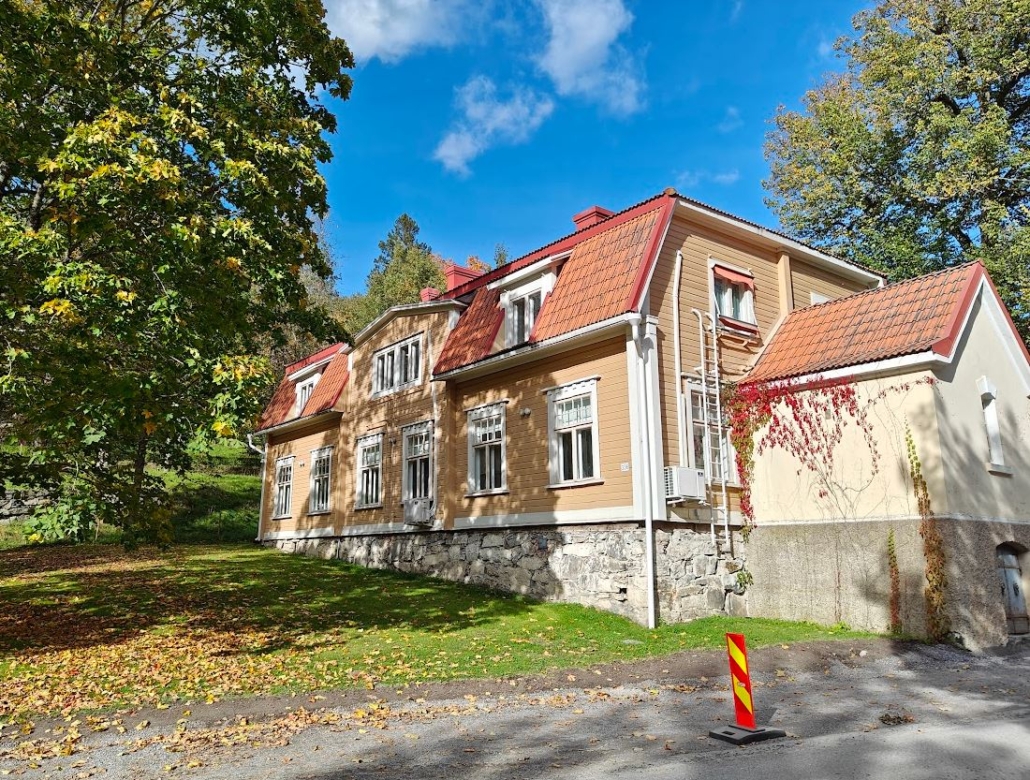
The river flows downwards, and I follow it. I admire the Ruukinkonttori house, bathing in the autumn sun along the main street, and decide to take a small detour further along Fiskarsintie road before heading up to the Tree species path.
A strikingly decorative red-gray slag brick building hides in its own corner between the main road and the river, with the river branching to flow on both sides of it. The clear stream is wonderful to watch. The former granary now houses a chocolate shop and exhibition spaces. This is one of my favorite buildings in Fiskars, and I am not surprised to learn that it is also a popular place for weddings.
I sit down for a moment at a table outside to watch the spot where the river, which had earlier branched in two, reunites into a single stream. It was here last May that I sat with a friend, eating chocolate made in the neighboring ironworks village of Billnäs, which we had bought from the shop.
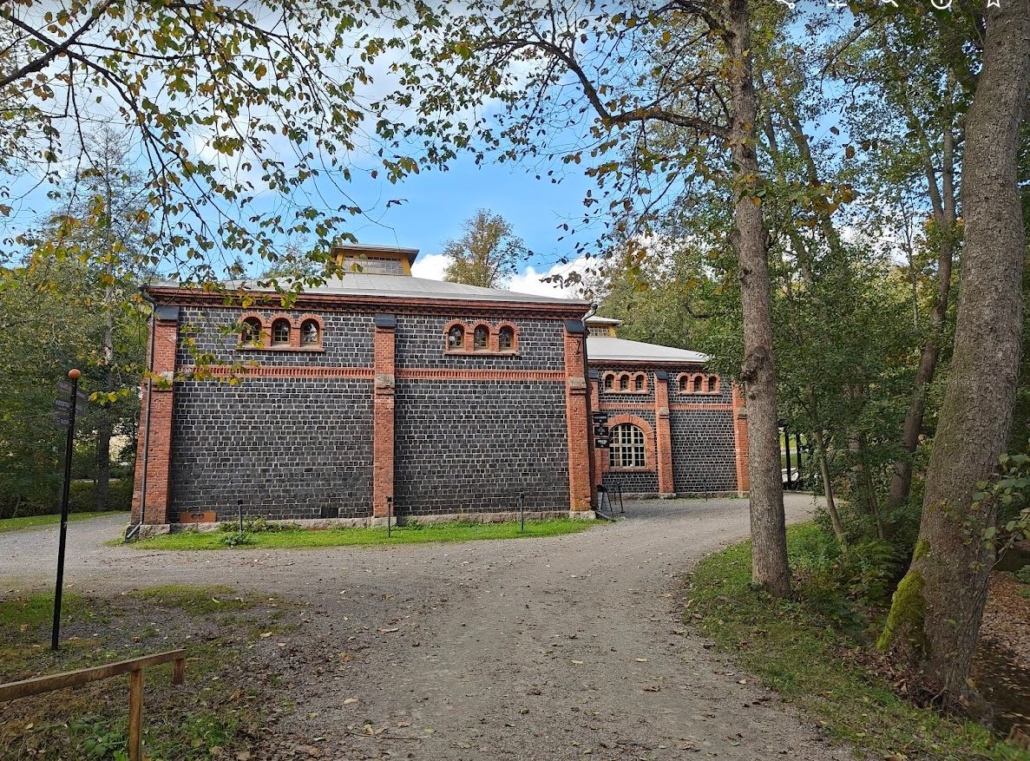
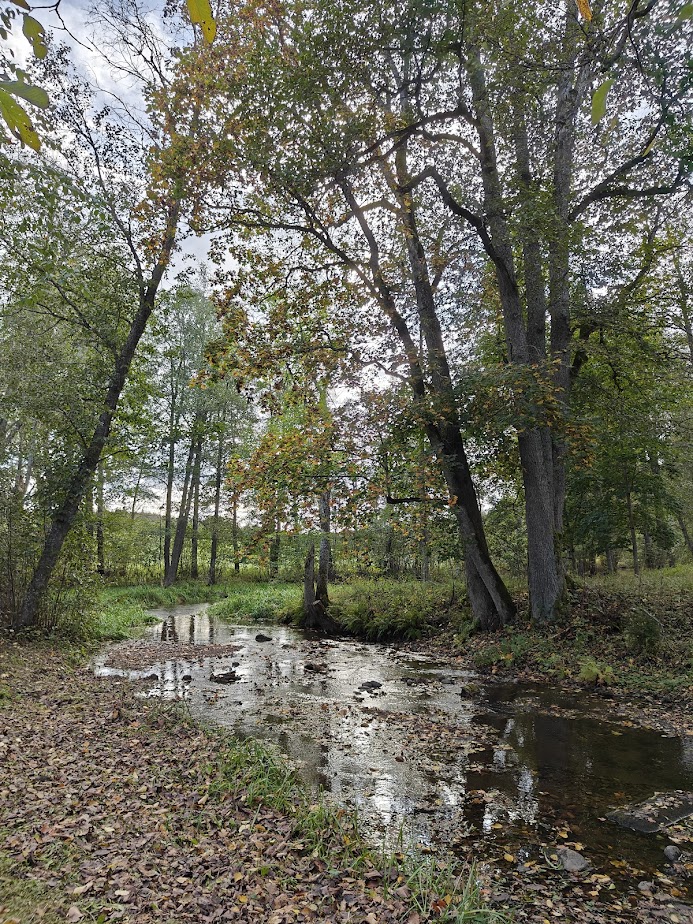
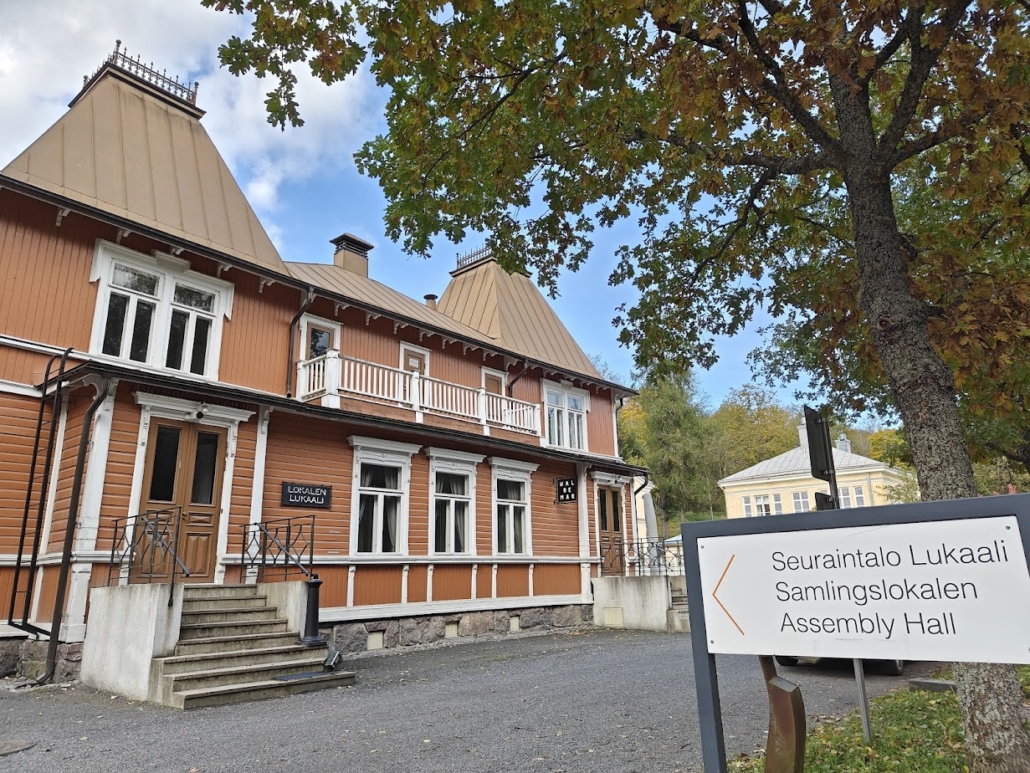
As a final detour before heading to the Tree species path, I go to see the old community center Lukaali, which reminds me of a building from the Moomin stories, and the nearby Fiskars Wärdshus inn, where my husband and I stayed last spring. We have a tradition of booking a hotel night in a different location for our wedding anniversary weekend, and this year, Fiskars was chosen specifically because of this inn. It is the oldest still-operating inn in the country and has been in operation since 1836 – almost two centuries! We were prepared for some serious haunting, if only because of the building’s age, but we slept so soundly that any potential haunting went completely unnoticed by us.
Fiskars Tree Species Path
- My starting point on the map
- Circular route 2 km/1,24 mi
- Lookout tower
While the Upper Works culture path circles the east side of the Fiskars River, the Tree Species path ascends the hill on the west side, directly behind the Könni clock tower. It winds its way along narrow paths around the hill called Lippukallio or Flaggberget (“Flag hill“) and descends back down to the main road amidst cottages and houses. At the top of the hill, it’s worth taking a detour to the low lookout tower.
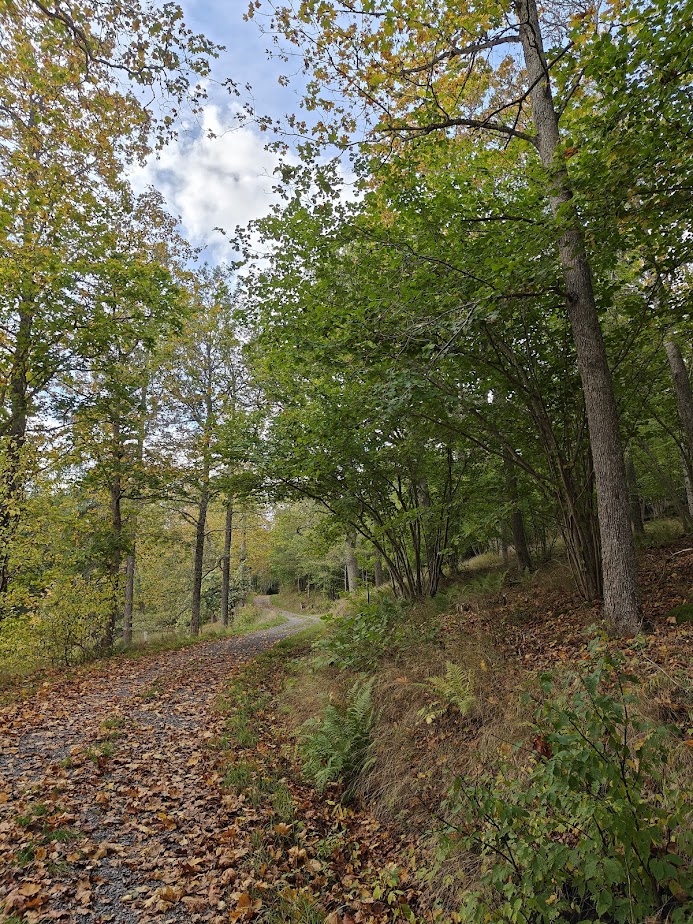
Just a few steps away from the heart of the ironworks, the atmosphere is completely different, though equally charming. The buildings are completely hidden at the start of the walk, replaced by a hazel grove that remains beautifully green even in October, along with a variety of large trees, such as oaks.

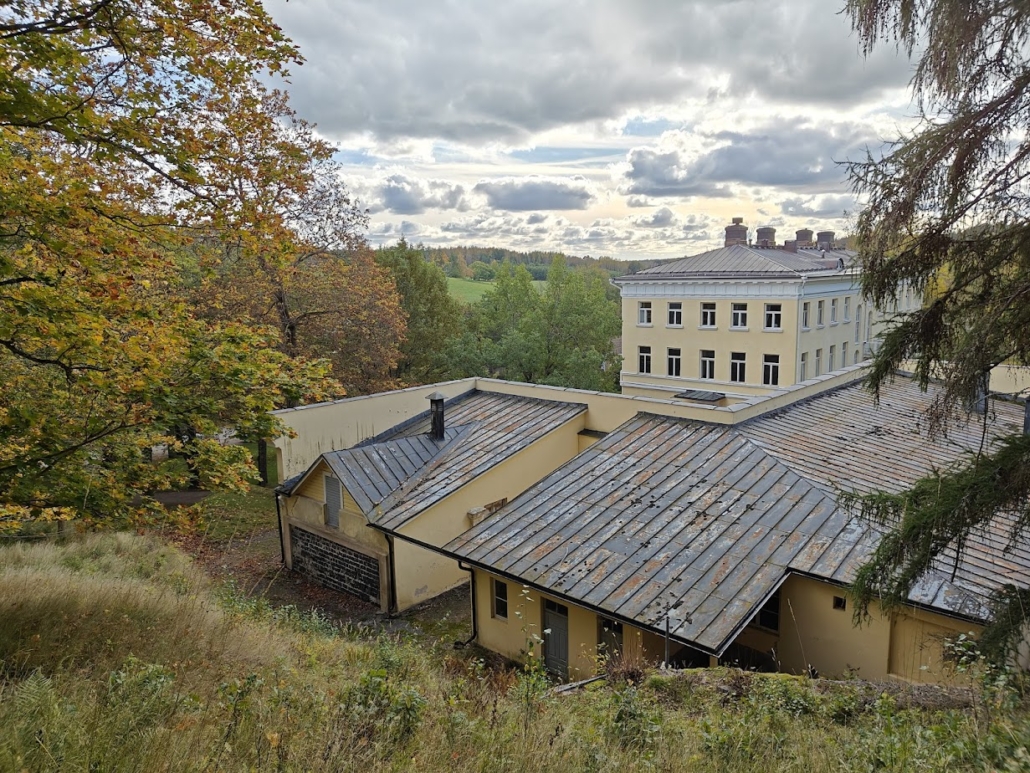
A narrow road, covered with maple leaves, leads clockwise up the slope of Lippukallio hill. Down to the left stands an impressive building amidst an aristocratic garden – Fiskars Manor, also known as Stenhuset. From the front, passersby can spot a sign with the familiar Fiskars name in the iconic font recognized worldwide – this old factory manager’s house is the representative building of Fiskars Group. Seen from behind on the Tree Species path, the landscape begins to open up as well.
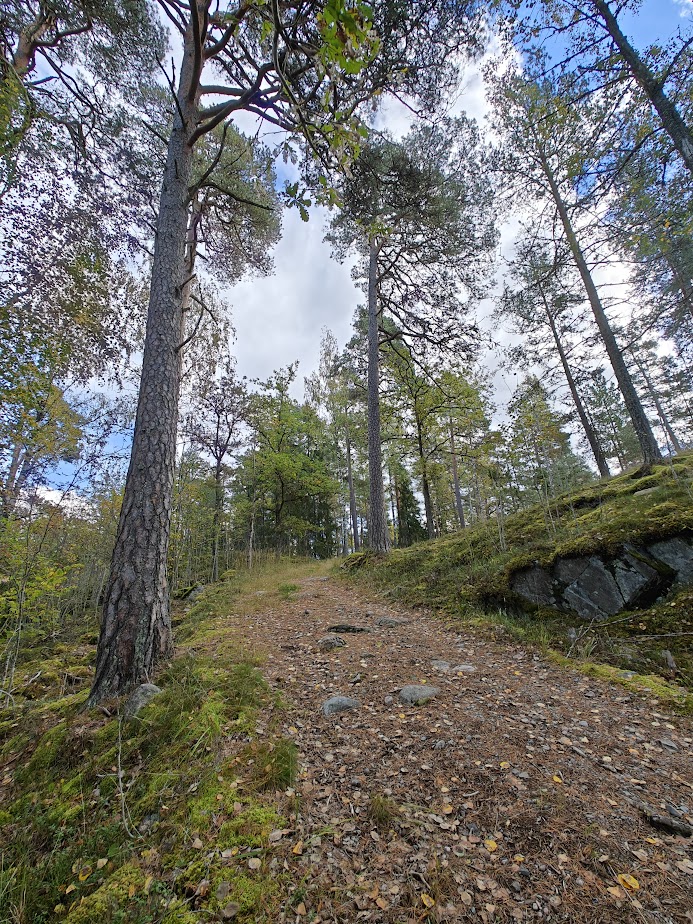
The road curves behind the hill, and the landscape changes once again. A narrow gravel path branches off the Tree Species path for a short distance, leading to the top of the hill, where a low lookout tower awaits. Just a few steps up provide a slightly better view, though the scenery is beautiful even from the base of the tower.
No more streets of the ironworks or even park-like groves, but instead, turtle-barked pines, rugged rocks, and gnarled, silver-gray deadwood trees! The summit of Lippukallio hill rises directly above the center of the ironworks, less than 300 meters away as the crow flies, yet neither gives a hint of the other’s existence. The openness and nature at the top of the hill are entirely different from what lies below. The view from the top doesn’t extend to the village but rather to the surrounding forests and fields. There are only a few scattered buildings visible in the landscape.
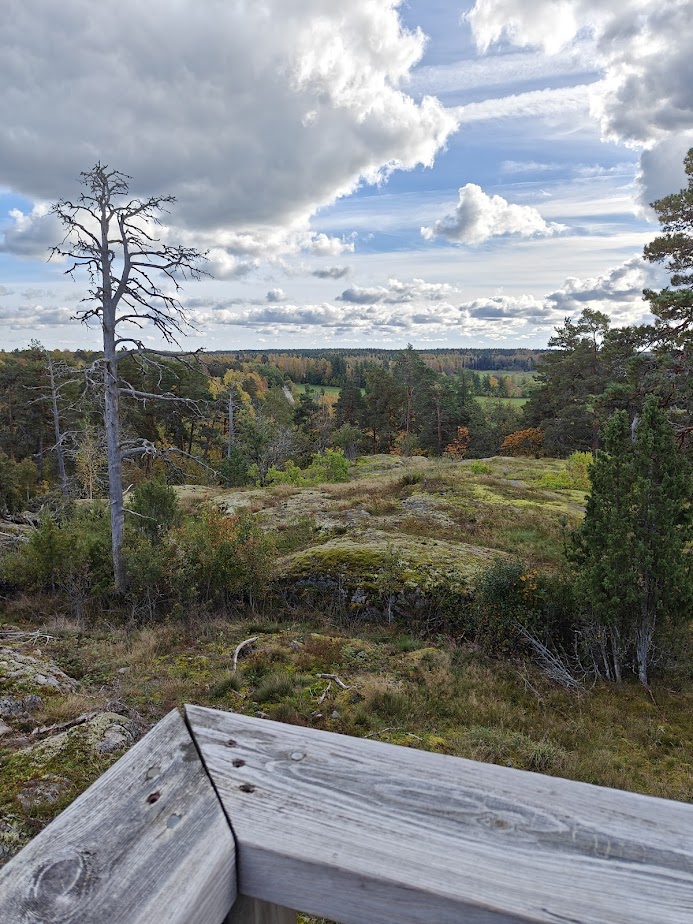
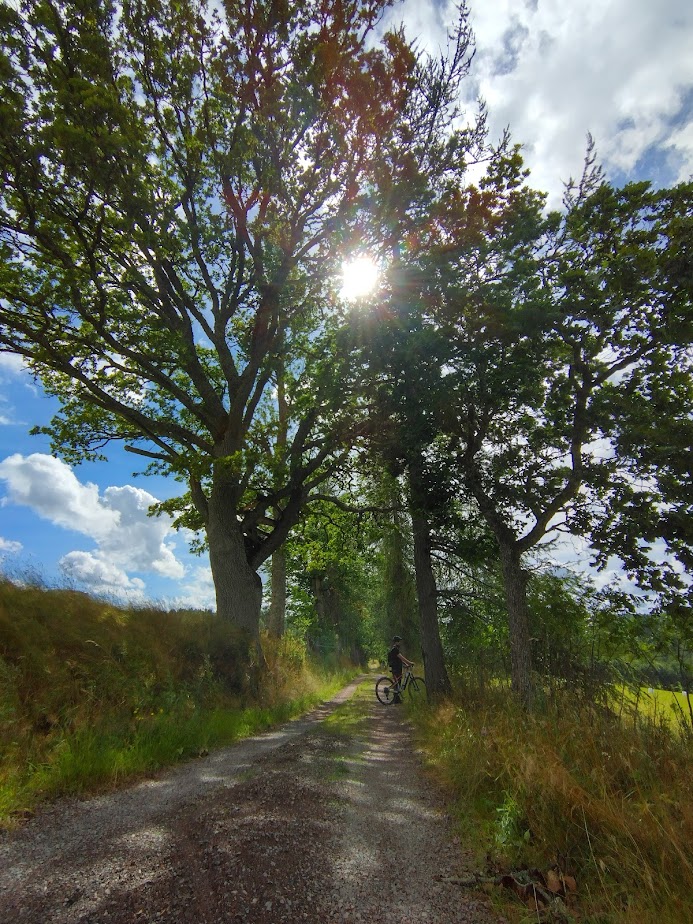
I gaze out at the landscape where I remember mountain biking with my husband a few summers ago. Fiskars has about 60 kilometers of mountain biking trails of varying difficulty levels, and we were trying out the easiest ones since I’m not exactly blessed with a daredevil spirit or a love for challenges, not in the slightest. We rented bikes from the Fiskars Village Trail Center, and even though I was a first-timer, I managed relatively well on the trails. Especially memorable from that trip was a field road lined with large oaks, located right on the outskirts of the village.
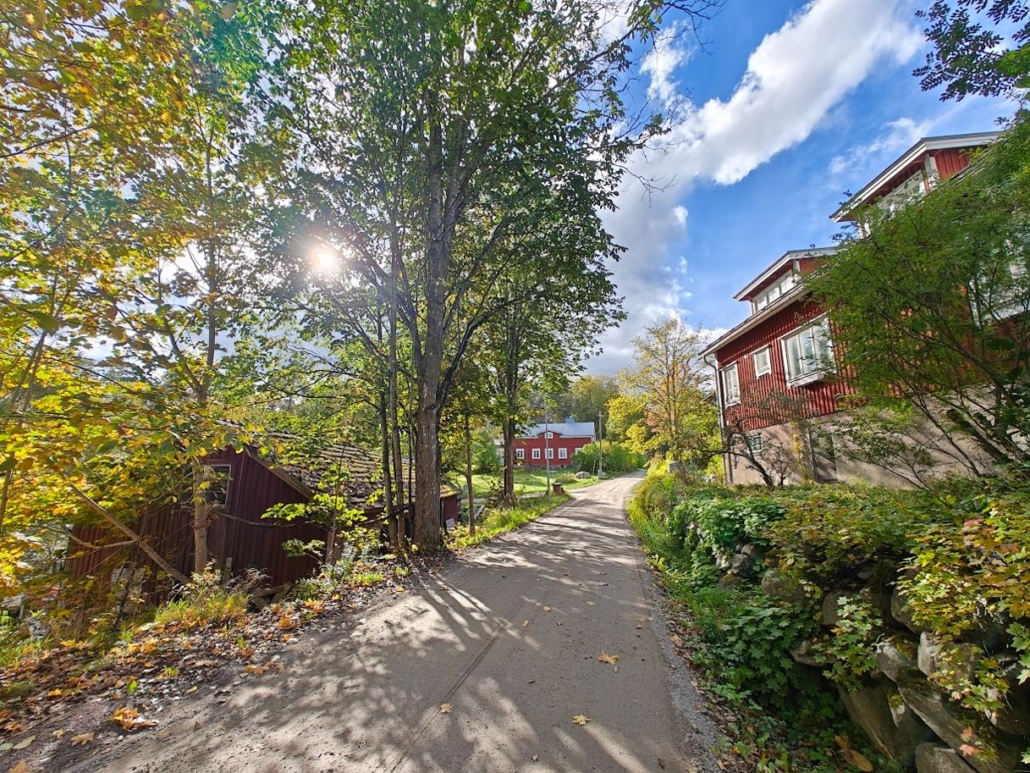
After Lippukallio, the Tree Species path dives back into the cottage and residential area. Houses of various sizes and shapes, but all predominantly red, line both sides of the route as it continues along Isokiskontie road.
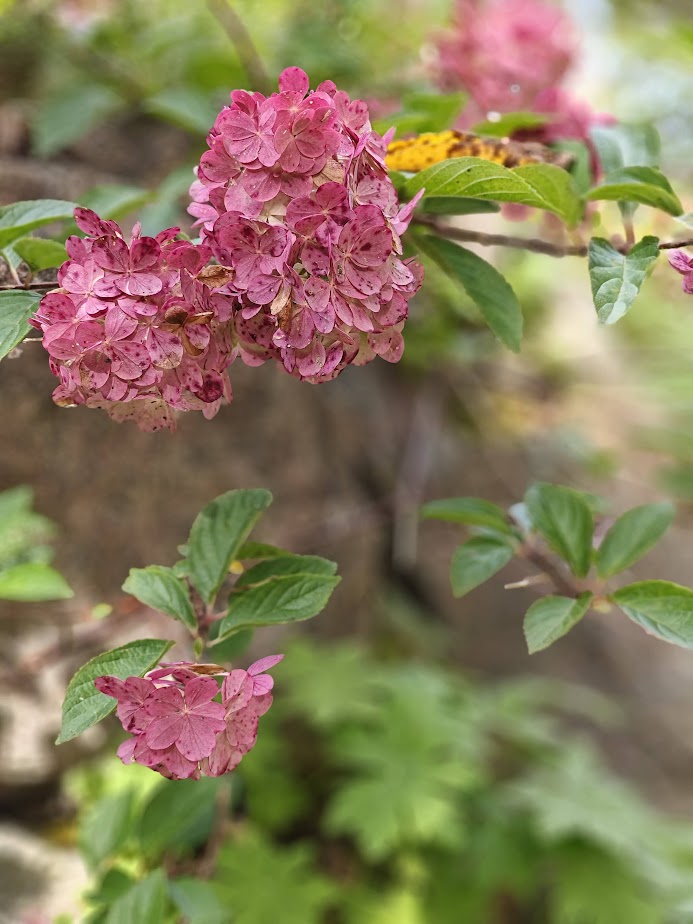
The turtle-barked pines and deadwood trees give way to the beauty of gardens and autumn’s vibrant colors. The sky, which had earlier clouded over, clears up again, and the afternoon sunlight brings out the full splendor of the yellow, red, and green hues of the various foliage and flowers. I thoroughly enjoy it!
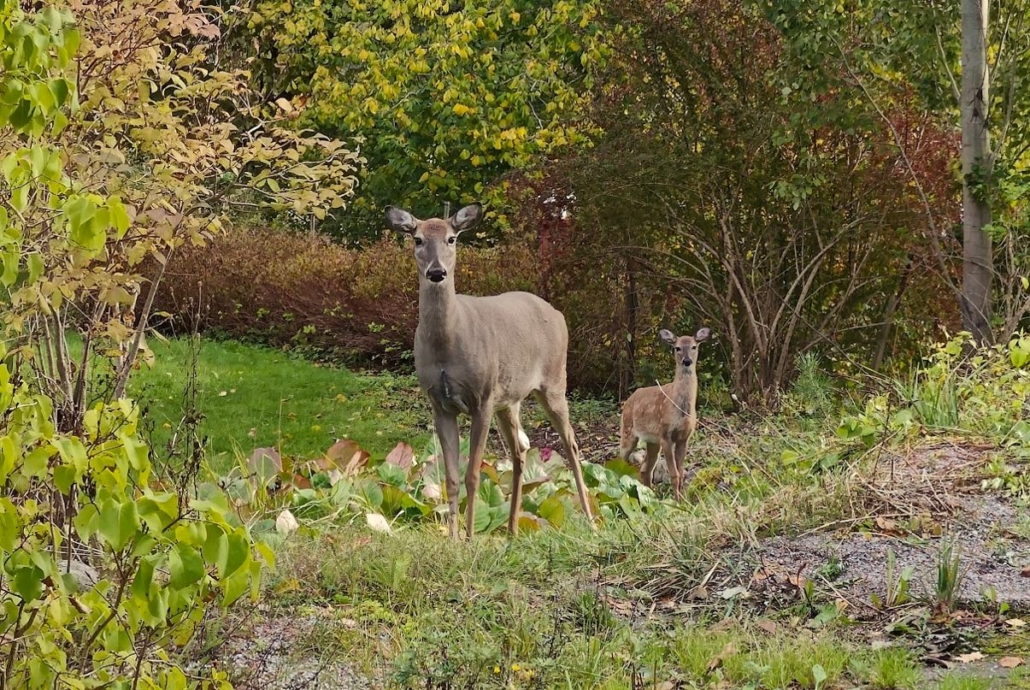
I glance at the map on my phone to confirm the route as the Tree Species path meanders back toward the village street, ensuring I’m on the right track. As I put my phone back in my pocket, I initially think I’m seeing a garden ornament, but a closer look reveals that it’s a living white-tailed deer. At this point, the distance between us is still about forty meters, and I notice that it is standing right by the roadside, where I’m supposed to pass. As I walk calmly closer, I also spot a fawn.
The hoofed animals of Fiskars are quite accustomed to people, as I’ve noticed before – when driving through the village, you often see them grazing on the roadside like reindeer in Lapland. This wide-eyed beauty doesn’t move away either, and I end up passing just a few meters from it and the fawn as I continue along the road curving to the right. I feel a sense of satisfaction every time I gain an animal’s trust and know that I am worthy of it.
I descend the final stretch downhill and pop back onto the main road near the parking area where my car is. But before returning to the car, it’s time for the most important part: afternoon coffee.
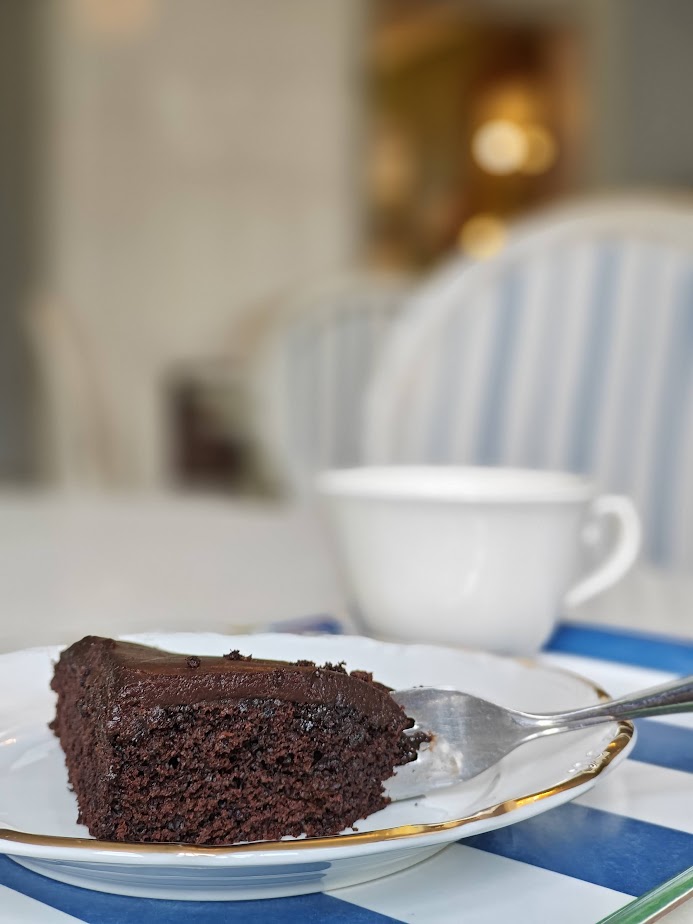
On the street terrace of Café Antique, a couple is enjoying what looks like a lovely, leisurely treat in the sunshine. I step inside the café and find a large slice of vegan mocha square that suits me perfectly. The dark pastry smells wonderfully of coffee and cocoa and melts in my mouth as I sit down to enjoy it with a cup of coffee in the café’s calm atmosphere.
A drowsy silence surrounds me, and a variety of bright, old dishes on the windowsill reflect the still, gentle light of the afternoon.
Arriving in Fiskars
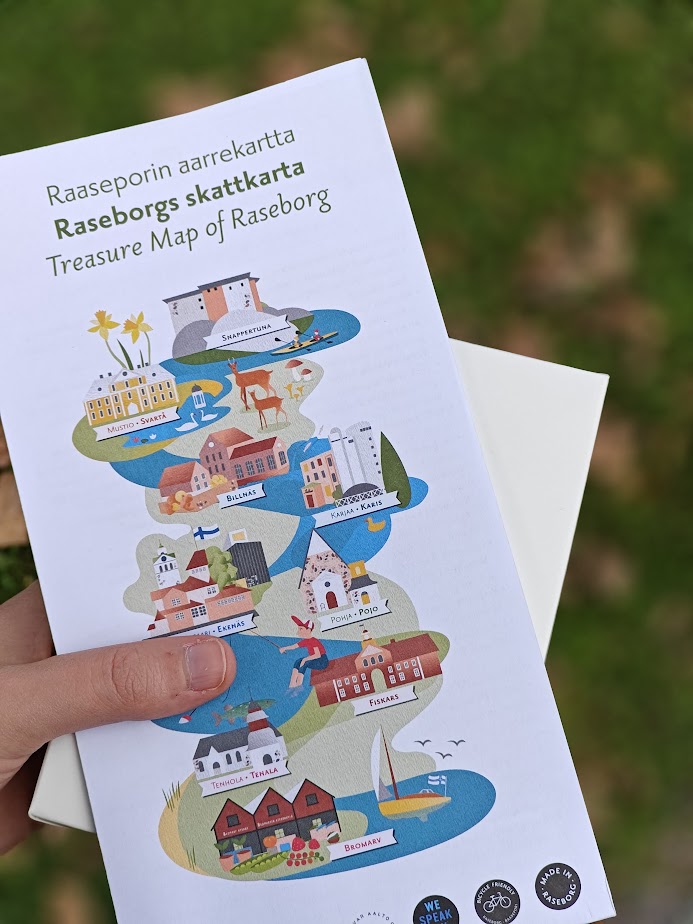
You can take a direct train from Helsinki and Turku to Karjaa/Karis in Raseborg.
Buses also travel directly to Karjaa from Helsinki.
Continue from Karjaa to Fiskars:
- By bus: The Raseborg local transport Bosse Route Planner is a handy tool! It makes planning a car-free trip to Fiskars easy. Check bus schedules well before your planned trip, as they do not run on weekends.
- By bike: The Ratavalli cycling route (12 km/7,5 mi one way) leads from Karjaa to Fiskars. Read about the route and explore summer in Fiskars: Culture & Cardio – Experience the Embankment Route from the Capital Region to Fiskars on a Train and Bike
- By car: Fiskars’ large parking area, where this story began, is located in the center of the village at Peltorivi 1, Raasepori/Raseborg.
Additional tips!
- Right next to Karjaa, at the end of a short walking route called Jokivalli, awaits the centuries-old Billnäs ironworks.
- If traveling by bus from Karjaa to Fiskars, note that there are other interesting spots along the same bus route. These include not only Billnäs but also Pohja/Pojo village, where you’ll find the 3.8 km/2,4 mi long Gumnäs nature trail and an ancient burial site with a stunning viewpoint. After passing Fiskars, there’s the small and charming Antskog ironworks.
Related Content



Leave a Reply
Want to join the discussion?Feel free to contribute!