
In the Finnish Woods: Finding Wellbeing for Body and Brain
I have just been reading a blog post about the beneficial effects of the forest on brain health. When, after a long day at work – tired from my job and weighed down by the news of the world – I pull a woolly hat onto my head, slip rubber boots on my feet, and step into the nearby forest, even a short mushroom-picking trip shows me that the blog post made many truly good points. I realize that my brain has gained an immense amount of health from forests throughout my life, even if I have not been fully aware of the many dimensions of this whole.
The article has been translated from Finnish and includes Finnish-language sources, which are listed at the end of the article.
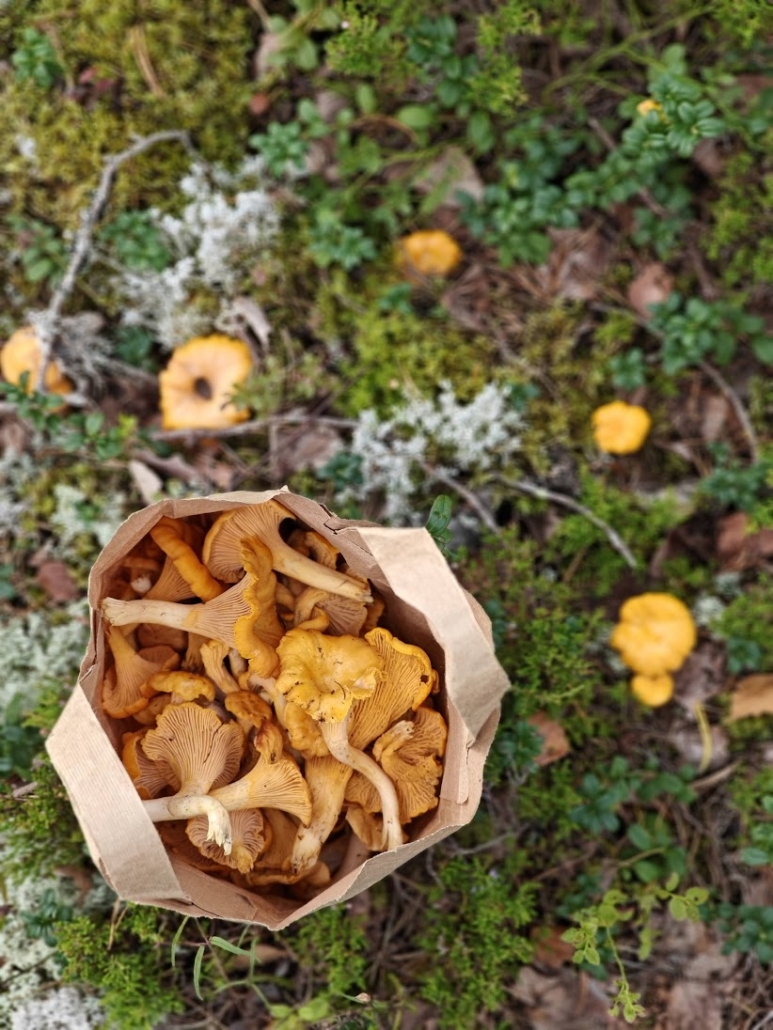
My husband is with me, and we have decided to take a walk to a familiar, secluded forest pond. We have come here every autumn, and I know that there are mushrooms to be found. Yet we are not here primarily for the mushrooms, but rather for the forest itself and the joy of being in it. Still, I have slipped a small bag into my pocket for possible sauce ingredients.
I have already mentioned a couple of the less obvious ways the forest benefits us: first of all, we are in the forest together, sharing social interaction. In my opinion, the forest is an excellent environment to be with another person or with a group. Simply existing, chatting (sometimes about difficult topics), and also enjoying peaceful silence all feel easy and natural in the forest. As someone socially rather awkward myself, I always prefer to meet new people in a natural environment.
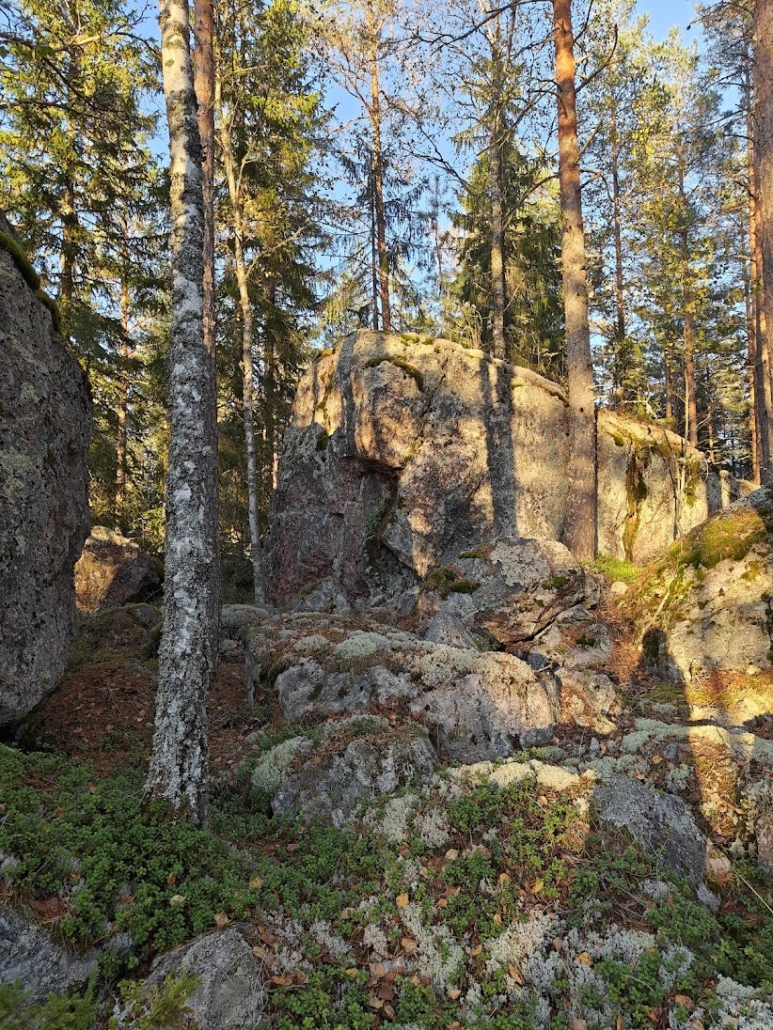
We follow a deer path forward and move from a bright pine forest into the shadows of a spruce grove. We are each other’s company, support, and safety, and wonderful memories also rise to the surface, since we have walked here before. My brain purrs with delight. It feels good to see this beloved place intact and unchanged. No trees have been cut down since our last visit, and my heart sighs with relief.

Mushrooms, too, are beneficial for health. Like good sleep, wild food is one of the forest’s ways of giving even after the trip is over. Mushrooms provide us with vitamin D and slowly digestible fibers, which help to keep us feeling full for a long time. They are low in calories and contain trace elements such as iron, zinc, and selenium. Especially when prepared in a healthy way, for instance with vegetables and olive oil instead of being drenched in butter and cream, mushrooms are a nutritious food.
We walk slowly forward in the tall, dim spruce forest. We breathe deeply of the fragrant, quiet, pure air. It is the latter part of September, and even here in Southwest Finland the air has recently taken on the crispness of autumn. By the path, in a deep bed of moss, I notice chanterelles and push my fingers down to their base. The moss and mushrooms feel cold and damp against my fingertips. I snap the mushrooms cleanly from the stem and tidy them up neatly with my hands. I brush off moss and soil right there on the spot. Usually it takes little time – I just snap off the dirty base and take along a clean mushroom.
With the same fingers, wiped only briefly on the hem of my jacket, I next pick the last bilberries of the season and pop them into my mouth. I can almost feel how the microbes of the forest do me good. Microbes from forest soil and its offerings affect “human somatic health, the gut, the skin, and mental wellbeing,” explains brain researcher Minna Huotilainen in an interview with Yle.
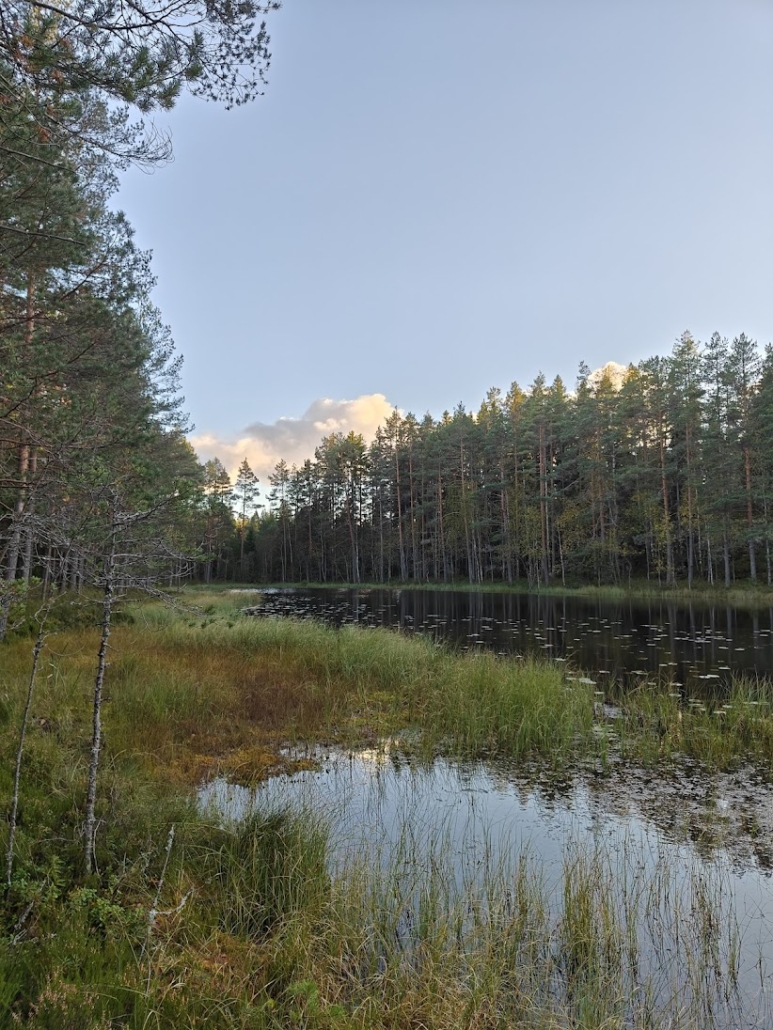
We are already deep in the forest. The familiar pond lies beside us, calm and still, utterly silent. The peace is perfectly unbroken. The swampy shores of the pond smell sharp and fresh in the cool evening air. For a moment, the sense of sight rests in the tranquility of the pond landscape, while the senses of smell and hearing grow sharper to enjoy the surroundings and even the smallest of its details. The scent is a mixture of moss, bilberries, Labrador tea, and the dark water of the pond.
I climb up a steep slope where I know I will find funnel chanterelles. This is yet another act of health the forest tempts me into – in the forest, exercise happens almost without noticing. Step by step, some of them challenging in the wet moss, on wobbly tussocks, and over tall roots, accumulate without effort. My brain enjoys coordinating my movements together with my body, evaluating the terrain ahead to find the best route and to spot mushrooms. At the same time, my muscles get a workout, and my sense of balance is engaged in a way entirely different from on the flat surfaces of the human-built world. When I can think about all this, the effect feels even clearer and more rewarding. I am fully present in my body.
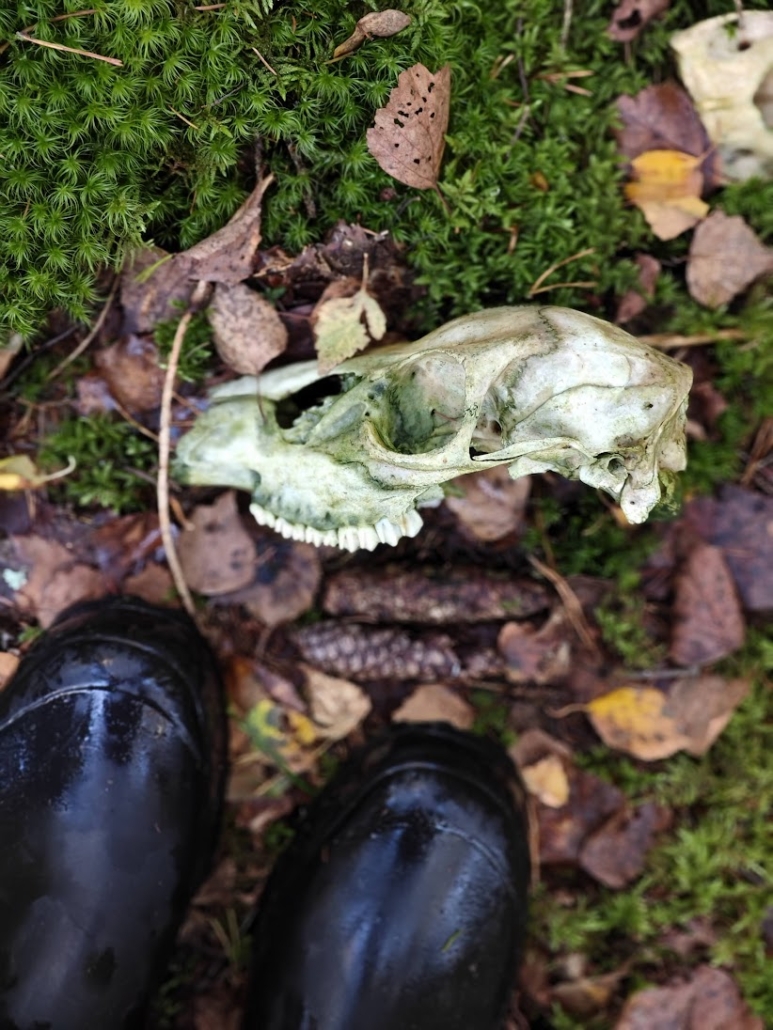
On the way, I notice a deer skull in the same place where I once found a pair of shed antlers. The skull is intact and already fairly clean. I leave it where it is, but I feel satisfied simply from having found it. This kind of treasure hunting is one of my favorite pastimes in the forest.
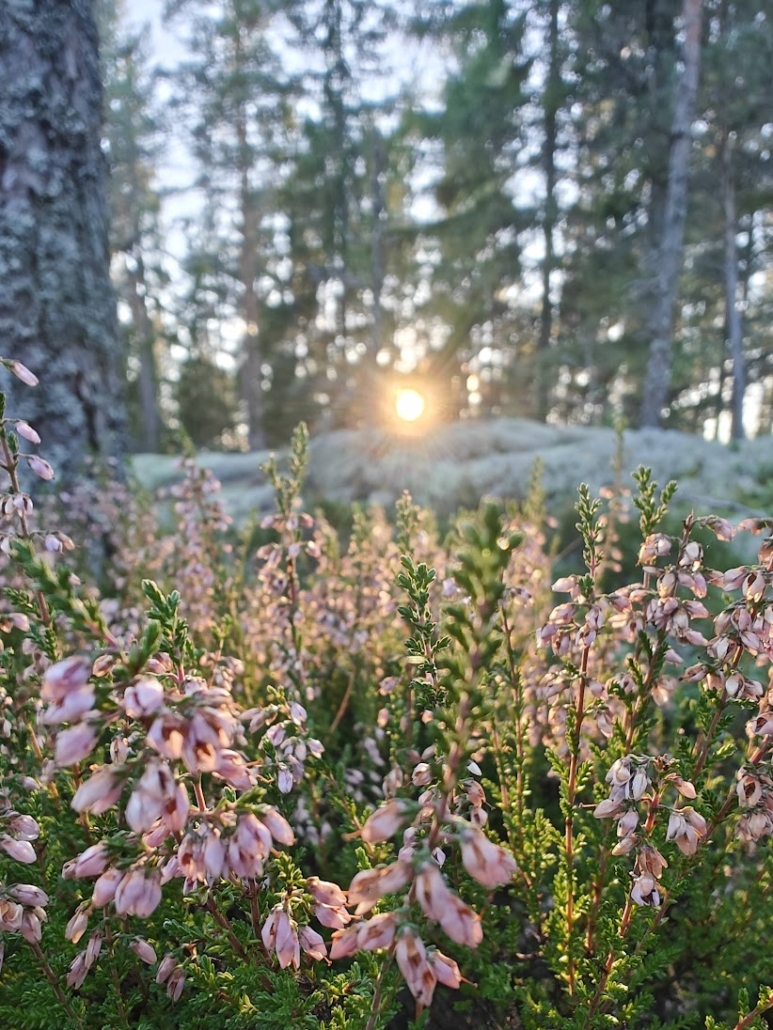
The sun begins to set, and because we are moving through hilly terrain, at times we are already in the dimness of shadow, while on the hilltops we can still enjoy the bright orange evening light shining over carpets of heather and lichen. The ground is littered with fallen logs, and around us rise trees of varying ages. We are not in any primeval forest, but still in one that feels far more like a real forest than a tree plantation.
“People recover more effectively in forests with an older age structure,” reported the Natural Resources Institute Finland last spring. This is something I can easily believe and wholeheartedly agree with. This time as well, both of us had entered the forest tired and worn down after a day of work, but now, after less than an hour in the forest, we feel refreshed and pleasantly energized once again.
It has been scientifically proven that spending time in the forest lowers blood pressure, eases stress and anxiety, and improves sleep quality, and in my own experience, I have also noticed that I often feel more hopeful in the forest. The older the forest, the better, and if it happens to be a nature reserve, the feeling is one of relief – I do not have to fear that the place will be destroyed before my next visit.
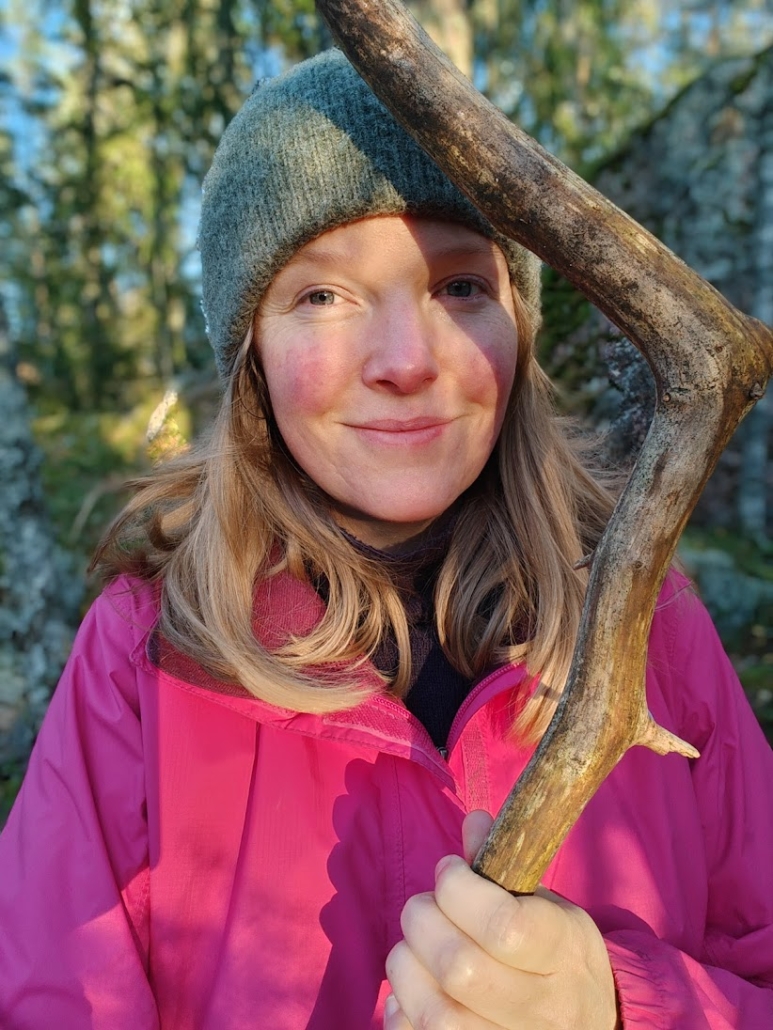
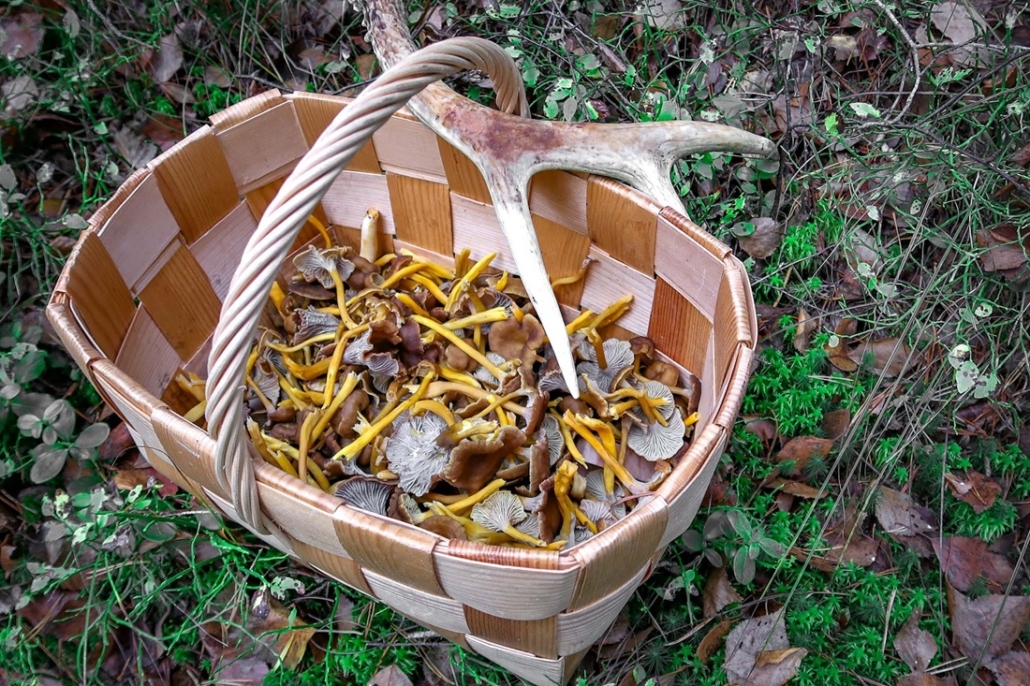
By now the bottom of the bag holds enough funnel chanterelles and chanterelles, along with a few black trumpets. I also carry with me a piece of wood I picked up from the ground, which I find to be an exceptionally fine stick – a rare discovery.
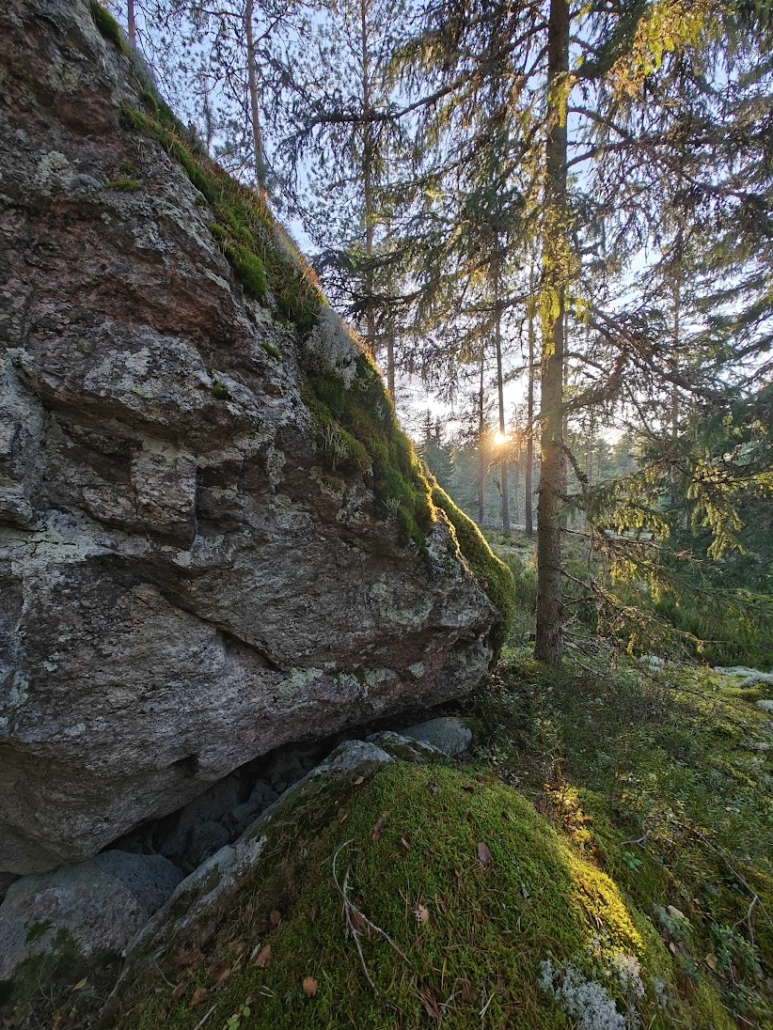
We are far from the human world, in an area where we walk regularly and where we have never encountered other people. The feeling is peaceful and safe. I dream of one day hearing an eagle owl’s hoot or the howls of wolves here, but this time it did not happen. We pause on large boulders to soak in the peace of the forest and the evening rays of the sun before heading home.
Thank you, dear forest, once again for everything.
Sources:
- Muistiliitto (The Alzheimer Society of Finland): Aivoterveyttä ja hyvinvointia metsästä, Tanja Kulmala, 21.03.2025
- Yle (Finnish Broadcasting Company): Suomalaiset syövät sieniä vähän ja väärin, 23.9.2015,
- Yle: Iho ja mielenterveys hyötyvät metsän mikrobeista – “Niitä ei saa purkista”, 2.10.2019
- Luonnonvarakeskus (Natural Resources Institute Finland): Ihminen elpyy tehokkaammin ikärakenteeltaan vanhemmissa metsissä
Read next
Caring for Mental Health in Nature: A Trip to the Baltic Sea’s Coastal Cliffs in Inkoo
Can you believe? This is how 15 minutes in a forest affects you!


Leave a Reply
Want to join the discussion?Feel free to contribute!