
A Temple of Steam at the Edge of Two Worlds: Finding Peace in Helsinki’s Kulttuurisauna, Cultural Sauna
Life is like a tree. Beneath the surface are the roots, the past, all the paths that lead to this moment and make it exactly as we experience it. This moment is the solid, sturdy trunk, and the future is the crown branching into limbs, where every branch, every leaf is one possible future.
Going to Kulttuurisauna made me nervous, even a bit scared. There’s very little information about the place anywhere. The website only provides bare practical information and mentions that it’s not advisable to arrive in groups, but rather alone or in pairs. The arrival time had to be booked in advance with five-minute precision.
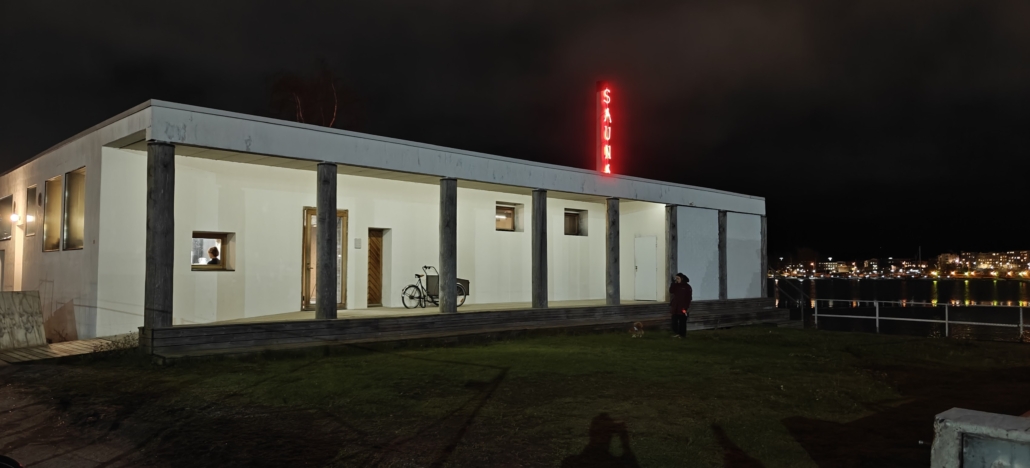
The sauna’s location and appearance only deepen its mystique. It’s right next to downtown, yet it’s its own island in a corner that has a timeless atmosphere. Its form has something ancient, Scandinavian, simultaneously Japanese-aesthetic, and yet also references to ancient Greece and Rome. And in the corner on the roof, a pyramid.
The same theme continues inside. Shoes are removed at the door and left on the shelf. A friendly greeting awaits at the kiosk window. The kiosk itself is very minimalist. There’s just a window, two people on either side, a counter with a water pitcher and a few metal cups, and behind the greeting person, a red letter board showing the venue’s prices and offerings very simply. No products are visible. We receive keys and seat covers. They ask if we’re familiar with the place. We answer no, and they tell us where to find the men’s changing room, where the toilet is, how to make löyly (steam), and how to access the sea. The water temperature is 6 degrees.
The same architectural dialogue between Scandinavian, Japanese, and Greco-Roman aesthetics continues inside. There’s minimal concrete, a tall continuous window, and massive wooden pillars. The doors are wooden, very simple. The changing room has only lockers and a group of minimalist stools that echo the building’s U-shape. Simple hooks on the wall. After the changing area is the shower room. In the concrete room, there are two concrete beams on one wall, a water basin between them, and two simple showers facing each other. We wash and continue to the sauna.
At the door, a simple instruction politely requests enjoying the silence. The benches are reached via concrete steps. Their dimensions fit perfectly with footsteps. I place my seat cover and focus on feeling, being. The heat is soft. Soon the atmosphere has taken hold of me and meditation begins. Making löyly doesn’t break it. It has the same unhurried quality and living in the moment as everything else found here. The stove is very different from anything I’ve seen elsewhere. A concrete cube with a small hollow on top, a chimney where water is slowly poured with a long-handled ladle. A deep hiss comes from within and the warmth spreads slowly and gently through the air. Occasionally the door opens. People’s conversation stops the moment they step inside. And soon every arrival catches the same state of mind.
I don’t know how much time passed when it was time to exchange heat for cool. We walked outside, to the courtyard enclosed by the building’s walls. A large birch grows in its center, and movement happens along wooden platforms. There are a few benches to sit on, steps leading to the sea, and the sea itself, beyond which a few lights are visible and darkness. Helsinki feels distant, though we’re right next to its center. I go into the sea. We sit, talk, and head back to the sauna. On the second round, the experience only deepens and reaches its peak on the third. I go to the sea one final time, then shower, and we get dressed.
We sit for a moment in the lobby area. It’s as minimalist as the rest of the sauna. A simple rectangular room with a concrete floor, where three walls are concrete, one is glass, and along the glass wall are wooden pillars at regular intervals. There are a few benches, a wooden block, stones arranged on the floor, a large kantele on the wall, a sofa and a table with two books and two magazines. One book is very small, black-covered, and inviting. It’s been read a lot. I read it too. It tells the sauna’s story, the thoughts behind it. They wanted to create a place where people could come as equals to be naked in warmth. A place where Finnish sauna and Japanese onsen meet. And colonnades reminiscent of ancient Rome and Greece. The sauna was desired in a location by the water, at the edge of the human world. In a place where air moves, because like stagnant water, stagnant air also begins to turn bad.
Kulttuurisauna opened in Helsinki’s Merihaka in May 2013. It was designed by architects Nene Tsuboi and Tuomas Toivonen, who also run the sauna themselves. The name has its own story, but it’s also true to its name as a cultural deed. Helsinki has had over 200 public saunas. When Kulttuurisauna opened, only a few remained. For five decades, no new public sauna had been built in Helsinki, an old sea spa town, in the country where Finnish sauna originates, in its capital.
The story of the name is as rooted as the sauna itself, and thanks for that goes to Alvar Aalto, by far Finland’s most famous architect and designer. As a young architecture student, Aalto had proposed building a sauna on top of the ridge running through Jyväskylä’s city center. Massive stone stairs had just been completed on the ridge as a city landmark.
“Mighty stairs with oversized stone railings lead to… where? Nowhere. They go into empty air.”
“Let’s build a sauna there! Not an ordinary semi-civilized caricature of the old Finnish sauna, as all our saunas currently are, but a culture sauna, a national monument, the first of its kind in Finland’s awakening civilization.”
These words Aalto wrote in an opinion piece, envisioning how the Finnish culture sauna would develop over centuries, like Rome’s monuments, into a beloved Finnish cultural attraction for all of us.
Kulttuurisauna is truly worthy of its name. I don’t know how it will be remembered centuries from now, but it creates culture. In a Helsinki Sanomat interview, Tuomas Toivonen says:
“There’s a devout, fine, focused atmosphere here. People practice bathing on their own terms. It’s magnificent to watch. When things go beautifully, you don’t need to do anything.”
And how during Kulttuurisauna’s first years, his main task was bathing. Instead of notes and prohibitions, the sauna attendant showed by example how to use the stove. Or how inappropriate conversation could be steered elsewhere.
You, who seek different sauna experiences, want and are able to grasp a unique atmosphere, moment and being that needs nothing else, this place is for you. Don’t be afraid. Come alone or in pairs and enjoy the silence.
Related Content
 Uusi Sauna / Sanna Kaesmae


Leave a Reply
Want to join the discussion?Feel free to contribute!